The Energy Trilemma Is Missing a Dimension. I Call It the Temporal Trilemma

Time is the missing component of the “Energy Trilemma”
In 2016 I argued that power, not compute, would be the binding constraint on data center infrastructure. That call is now the whole story, and it exposes something the energy trilemma was never built to show.
The trilemma asks you to balance security, affordability, and sustainability. It is drawn as a triangle. A triangle is a still picture, and the thing it describes no longer holds still.
Here is why that now matters.
Demand stopped drifting and started spiking. The IEA reports data center electricity demand rose 17% in 2025 against 3% for electricity overall, and expects it to double by 2030 with AI demand tripling. In the UK, the proposed data center pipeline could need 50GW, more than the country's entire current peak.
And the balance is moving backward, not just sideways. Facing multi-year grid waits, developers are choosing speed and paying for it on sustainability: roughly 30% of planned capacity is now expected on-site, dedicated gas plants are being built for single sites, and operators are islanding off-grid for years. A decade of decarbonization can be set aside in one procurement cycle.
The trilemma cannot represent any of this, because it has no time axis.
So I have named the missing dimension: the temporal trilemma. Not a fourth corner. Time is not another thing to balance. It is the axis the three corners travel along, and it now moves fast enough, and reversibly enough, that ignoring it produces bad decisions.
If the problem is temporal, the answer is sequencing. That is the work the Structured Transition Model does: decide what to deploy now, what to run as a bridge, and what to converge on, so today's speed requirement does not foreclose tomorrow's sustainability requirement.
Full piece here: The Temporal Trilemma: The Missing Axis in the Energy Trilemma
An approach for data center developers to address the temporal trilemma - the Structured Transition Model
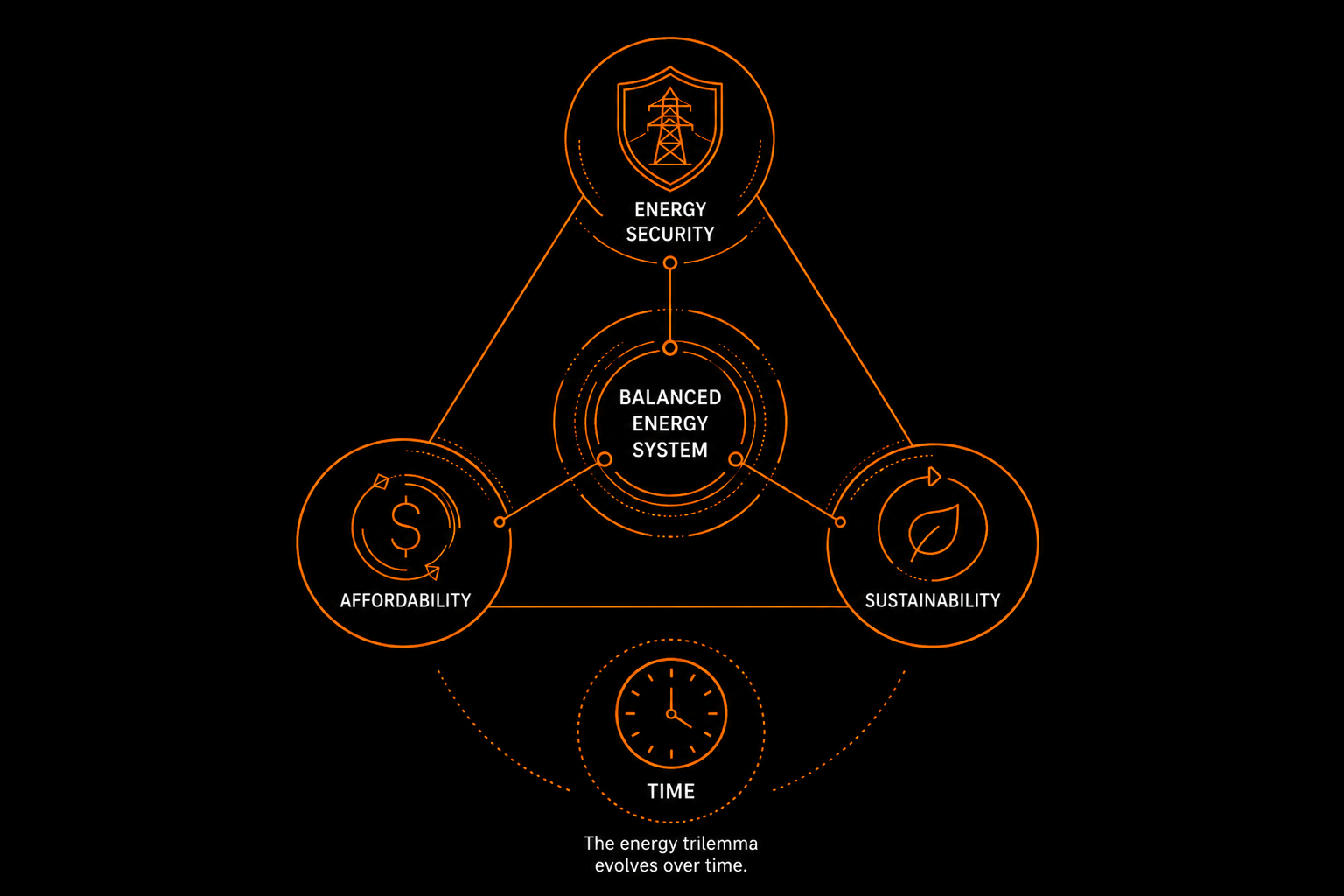
The temporal trilemma
More Reading
Questions and answers
What is the energy trilemma?
It is the idea that an energy system has to balance three goals that pull against each other: security (keeping supply reliable), affordability (keeping it accessible), and sustainability (lowering its environmental impact). The World Energy Council has measured countries against these three dimensions since 2010. The core lesson is that improving one corner often costs you on another.
What is the temporal trilemma?
It is the same three corners with one addition: the axis of time. The standard trilemma is drawn as a static triangle and tells you what balance to strike. The temporal trilemma observes that the balance point moves, that it can now move quickly, and that it can move backward as well as forward. It is the trilemma understood as a system in motion rather than a snapshot.
Who should be thinking about the temporal trilemma, and at what stage?
Anyone making an irreversible power decision on an AI infrastructure timescale: developers choosing between a grid connection and on-site generation, operators sizing a bridge solution, investors underwriting a project's carbon exposure over its life. The stage that matters is the procurement decision, because that is where a choice made for speed today quietly sets your sustainability position for years. The trilemmaframing makes that trade-off invisible. Naming the time axis makes it a decision you take deliberately rather than one that happens to you.
How does the temporal trilemma relate to speed to power?
Speed to power, the time between project approval and energization, is the force driving the whole problem. It is the reason the balance is moving fast and moving backward: when energization speed becomes the binding constraint, sustainability is what gives way. Speed to power describes the pressure. The temporal trilemma describes what that pressure does to the three corners over time. The Structured Transition Model is how you respond to both without foreclosing your future position.
Isn't it obvious that the trilemma changes over time?
That it changes is obvious. The rate and the reversibility are not. Energy systems used to move slowly enough that an annual review captured the drift. AI infrastructure introduced a fast transient, demand arriving on a timescale the planning system was never built to match. And the movement is not one-way. A decade of decarbonization progress can give ground in a single procurement cycle when speed becomes the binding constraint. That is the part the static framing misses.
Why does this matter for AI data centers specifically?
Because AI infrastructure is where the transient is largest and fastest. The IEA expects data center electricity demand to double by 2030 and AI-specific demand to triple. Faced with multi-year waits for grid connection, developers are choosing speed: on-site generation, dedicated gas plants, off-grid islanding. Each of those is a decision to trade sustainability for delivery time. The trilemma cannot represent that trade, because it has no time axis. The temporal trilemma is built to.
Is time a fourth dimension, making this a quadrilemma?
No, and the distinction matters. A quadrilemma would add a fourth thing to balance. Time is not a thing to balance. Nobody optimizes for speed as an end in itself; speed is a constraint imposed by demand. Time is the axis the existing three corners move along. Adding it as a fourth corner would confuse a constraint with a goal. The temporal trilemma keeps three corners and adds the dimension they move through.
If the balance is always moving, how do you manage it?
You sequence. Rather than picking a single balance and defending it, you decide what to deploy now, what to use as a bridge, and what to converge on, so that meeting today's speed requirement does not foreclose tomorrow's sustainability requirement. That sequencing discipline is what the Structured Transition Model sets out. The trilemma asks which balance. The temporal trilemma says the balance will move. Sequencing is how you stay ahead of it.