A Structured Transition Model for AI Data Center Power
A framework for powering AI data centers without stranding the investment
Authored by Alex Marshall, published by Rehlko.
The Structured Transition Model is a way to design power infrastructure for AI data centers so that it is reliable on day one, addressing immediate speed to power needs, and still improving a decade later. It treats power as a managed trajectory rather than a fixed endpoint. Reliable capacity is deployed now, using proven and fuel-flexible generation. Hybridization and decarbonization are then layered in over the life of the asset, without replacing the core system. Systems benefit from adaptability over time, both at the split second level, the day and over the facility’s life. I developed the model across two decades of building distributed power in markets where the grid could not be relied on, and the full framework, with lifecycle carbon modeling and worked examples, is published in a white paper and microsite now available to download from Rehlko.
The argument behind it is simple. The question is no longer how to minimize emissions at a single point in time. It is how to deploy reliable power at speed while keeping the ability to improve it over fifteen to twenty years of operation.
"I think (the Structured Transition Model) is a very thoughtful and much needed addition to the discussion around distributed power especially in data centers. In many of my advisory conversations, the mismatch between building 25+ year life data center assets and expecting to design in a single set of static generation assets comes up as an underappreciated and almost always unresolved paradox. Providing a framework for gradual evolution inside the broader grid development is brilliant and much needed."
Robert Nursterer, ex-President, Cummins Power Systems
I first set out this model originally in February 2026, in an article titled "Engineering for Up-time. Now Engineering for Trajectory". The framing then is the framing now. The first phase of AI infrastructure was about securing power. The next phase is about balancing reliability, cost, and carbon across the full life of the asset. Uptime alone is no longer the whole story. Trajectory has to be engineered.
I have also set out the wider context to the Structured Transition Model in my book “Five Nines and Fast Power”
The Structured Transition Model Outline
The Structured Transition Model in 60 Seconds
The model
Deploy reliable, fuel-flexible generation now, then decarbonize it over the life of the asset without replacing the core system. Power is treated as a managed trajectory, not a fixed endpoint, which is why speed to power becomes an enabler of decarbonization rather than a barrier to it.
The three phases
With projects able to enter at any one.
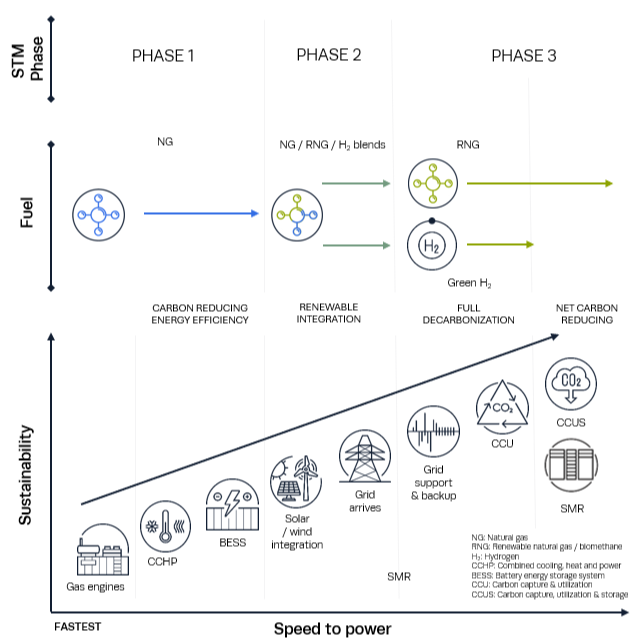
Phase 1, Foundation (years 0 to 5): proven, dispatchable generation delivers reliability and speed, specified to take lower-carbon fuels later.
Phase 2, Hybridization (years 3 to 10): add renewables, storage, combined heat and power, and fuel blending, and begin earning grid revenue.
Phase 3, Deep decarbonization (years 7 to 20): transition to renewable fuels and carbon capture, with on-site generation held as strategic resilience.
Why it matters
Reliability holds the whole way through, carbon falls across the asset's life rather than only at commissioning, and the core infrastructure is never stranded.
Why traditional power planning is failing
It has been clear since 2016 that power, not compute, would become the binding constraint on digital infrastructure. That was years before the AI boom made it obvious. The conviction did not come from forecasting. It came from watching the same pattern repeat across earlier infrastructure cycles, in waste-to-energy and across two decades of distributed generation, particularly in the commercial and industrial space, where grid stability was driving the market towards self-generation of power and microgrids. A novel demand appears, capital moves fast, assets are committed to a single end-state, and a large share of them are stranded within years. Not because the technology failed, but because the grid, the fuel economics, and the policy around them kept moving.
The data is now catching up to the point. The International Energy Agency finds that AI data centers are becoming one of the fastest-growing sources of electricity demand worldwide, with grid capacity and infrastructure, rather than compute, emerging as the primary constraint on scale. The U.S. Department of Energy has warned that without new firm capacity and a change in planning approach, most U.S. regions face unacceptable reliability risk within five years, driven largely by data center load growth.
Developers are being pushed toward a false binary. Move fast with carbon-heavy, energy-inefficient backup and accept high emissions, or pursue a renewables-only strategy that may delay the project and leave reliability uncertain. Neither reflects how complex infrastructure actually evolves. Waiting for a perfect zero-carbon solution usually means non-deployment, which defers the economic value, the digital capacity, and the climate benefit all at once.
AI load makes the problem sharper. These are not the stable, predictable load profiles that power systems were planned around. Training workloads create step changes in demand as clusters come online. Inference adds variability tied to user activity. The result is high power density, rapid scaling, and behavior that is less linear and more sensitive to infrastructure constraints than earlier generations of data center. That favors modular, fast-responding, part-load-efficient generation deployed in step with IT load, and it penalizes large, indivisible assets and long lead-time grid upgrades.
The principle: reliability now, flexibility over time
The model rests on one engineering principle. Infrastructure should be designed as a flexible transition pathway, not as a fixed endpoint.
It is not defined by any single technology. It is defined by what the assets have to do: respond fast, run efficiently at part load, accept more than one fuel over their life, and operate inside a dynamically controlled microgrid. Generation that meets those requirements can carry a site from reliable supply today to a low-carbon system later without being ripped out and replaced.
This is why speed to power is a sustainability enabler rather than a tradeoff against it. Bringing efficient compute online early, on a platform that is built to decarbonize, delivers value sooner and starts the carbon-reduction trajectory sooner. The objective is not perfection on day one. It is a credible decarbonization pathway over the life of the asset, with the reliability envelope held the whole way through.
The three phases
The pathway is set out in three phases for clarity, but it is not a fixed sequence. A project can enter at whichever phase matches its site conditions and strategy, provided the design stays compatible with the phases on either side. A grid-constrained hyperscale site might start at Phase 1. A site with strong low-carbon grid access and renewable supply contracts in hand might begin at Phase 2 or Phase 3.
Phase 1, the reliability foundation (roughly years 0 to 5). Deploy proven, bankable, dispatchable generation that delivers immediate reliability and autonomy. Reciprocating gas engines are central here because they respond fast, run efficiently across a wide load range, and are available in modular blocks. Reliability is built in through redundancy, typically N+1 or higher, so units can be taken offline for maintenance without compromising availability. That supports four to five nines, meaning 99.99 to 99.999 percent availability, in line with Tier III and Tier IV standards. Three design choices make this phase a foundation rather than a stopgap: select generation that can move to lower-carbon fuels later, avoid bespoke architectures that block later integration, and prepare the electrical topology for multiple input sources from the outset.
Phase 2, hybridization and optimization (roughly years 3 to 10). Once operations are stable, the system is hybridized to cut emissions and cost while adding flexibility. This is where combined cooling, heat and power, known as CCHP, becomes central. Waste heat from the engines is recovered and, through absorption chillers, converted into cooling, which directly reduces the electrical load that data center cooling would otherwise draw. Battery energy storage systems, or BESS, are added to smooth AI load variability and to enable participation in grid markets. Renewable electricity comes in through power purchase agreements, and the fuel begins to shift through renewable natural gas, or RNG, and hydrogen blending. Advanced controls orchestrate the mix. At this point the engines start migrating from continuous duty toward a balancing and resilience role, and the site becomes an active grid participant rather than a passive consumer. That unlocks value stacking: capacity markets, ancillary services, demand response, and energy arbitrage, which improve the economics of the whole system.
Phase 3, deep decarbonization (roughly years 7 to 20). This phase shifts the focus from optimizing the system to transitioning the fuel and deepening grid integration, without disturbing the core infrastructure. The fuel mix moves toward renewable gases, including direct biomethane substitution and, where equipment and safety codes allow, hydrogen blending or conversion. Carbon capture, utilization and storage, abbreviated CCUS, can be added to address residual emissions. On-site generation now functions primarily as strategic resilience capacity, preserving uptime during grid disturbances. The assets installed in Phase 1 remain fully usable throughout, because the electrical topology accepts multiple sources and the engines were specified for lower-carbon fuels from the start.
Reliability is internalized, not externalized
In a grid-only architecture, reliability is outsourced. Availability depends on transmission, generation adequacy, and grid stability, none of which the operator controls. Diesel backup adds resilience but is built for infrequent, short-duration use, not sustained or flexible operation.
The Structured Transition Model takes reliability inside the site boundary. Dispatchable generation is part of the primary architecture, not a contingency. The site can run independently of grid constraints when it has to, and synchronize with the grid when supply is available. As the system hybridizes and the engines move toward a balancing role, the reliability envelope is preserved rather than traded away. Storage improves transient response, and grid connection, where available, adds another layer of supply diversity.
Lifecycle carbon, not day-one carbon
Procurement often optimizes for first-year emissions. That produces designs that look good at commissioning and underperform over the asset's life. Carbon performance actually depends on when the project is built, how the local grid evolves, what lower-carbon fuels become available and at what cost, how the asset is dispatched, and when it is refreshed.
A system that looks imperfect on day one can outperform the alternatives over its lifecycle if it brings efficient compute online earlier, allows renewables and storage to be added incrementally, and avoids wholesale replacement as markets and technology mature. The model therefore evaluates total lifecycle impact, not a static snapshot. The full lifecycle carbon modeling, including worked examples across natural gas, CHP, hydrogen blends, RNG, and carbon capture, is set out in the white paper.
Designing for political and regulatory uncertainty
Power infrastructure for AI data centers runs for fifteen to twenty years, often longer once engines are overhauled or repowered. Over that horizon the policy environment will not hold still. Across a typical asset life, a reasonable expectation is eight to fifteen meaningful policy interventions: shifts in federal priorities, new legislation, rulemaking cycles, state-level changes, and reforms to electricity market design.
The model does not try to predict the policy of the 2030s or 2040s. It assumes change is inevitable and prioritizes the architectural characteristics that stay viable across regimes: deployability today, high efficiency, fuel flexibility, hybrid-ready design, and modularity. The central insight is straightforward. The greatest long-term exposure is not regulatory change itself. It is deploying infrastructure that cannot adapt to it.
Where it fits, and where it does not
The model is deliberate about what it does not treat as core. Gas turbines are a proven form of dispatchable generation and remain well suited to very large, steady, high-utilization campuses and to applications needing high-grade industrial heat. They are less suited to the frequent cycling and part-load operation that dynamic AI load demands, so within the model they are evaluated on their operating characteristics rather than treated as a default.
Nuclear is frequently cited as a zero-carbon baseload answer. It may play a major role in national grids over multi-decade horizons, but development timelines, permitting complexity, and large indivisible capital commitments place it outside the practical decision window for most data center developments today. It is best understood as a future grid characteristic that flexible, transition-ready architectures are designed to accommodate, not as a transitional technology inside the model.
The framework also sits alongside broader industry standards. It works as an execution layer for the Power dimension of the iMasons Climate AccordMaturity Model, translating maturity objectives into deployable power architectures. The role of combined heat and power as an enabling technology for efficient, resilient data center development is set out in analysis from the Cogen World Coalition, and the system-scale climate value of biomethane is quantified by the World Biogas Association.
The full framework
The full white paper expands it with lifecycle carbon metrics, detailed system architectures, the worked carbon example, and the overlapping transition phases applied to real grid and policy conditions. It is published by Rehlko and available to download there.
Why Now?
AI power demand is accelerating. Data center electricity use is on track to more than double by 2030 to around 945 terawatt-hours, from roughly 415 in 2024, which the International Energy Agency puts at about four times the growth rate of overall electricity demand, with AI-optimized facilities projected to more than quadruple.
Grid expansion is slow. A project reaching commercial operation in 2024 spent on average about four and a half years in the interconnection queue, up from under two years in 2008, according to Lawrence Berkeley National Laboratory. More than 2,000 gigawatts is now waiting to connect, close to twice the installed U.S. fleet.
Power has become the bottleneck. The International Energy Agency identifies grid capacity and infrastructure, rather than compute, as the primary constraint, and warns up to a fifth of planned data center projects could be delayed without transmission investment. The U.S. Department of Energy has warned that retiring firm capacity alongside this load growth could sharply raise the risk of power shortfalls by 2030, with data centers driving roughly half of the projected rise in peak demand.
Infrastructure decisions last decades. Prime power generation typically operates for twenty years or more. A decision made in 2026 sets a site's cost, carbon, and reliability profile well into the 2040s.
The wrong architecture creates stranded assets. A system committed to one fuel, one operating mode, or one end-state is the one most likely to be stranded when policy tightens, fuel economics shift, or firm grid capacity finally arrives. The decision that protects capital is not which fuel to choose today. It is whether the architecture is built to adapt.
Development of the Structured Transition Model
February 2026 – Initial STM concept published on LinkedIn.
May 2026 – Framework presented to select industry audiences.
June 2026 – Formal white paper released by Alex Marshall and Francis Perrin, Rehlko at DataCloud Cannes 2026.
June 2026 – Whitepaper published in parallel by Rehlko
“The Structured Transition Model is a valuable contribution to how the data center sector approaches defossilization of onsite power. By positioning combined cooling, heat and power (CCHP) as a practical and credible step on the pathway to sustainability rather than a legacy technology, (this) work reinforces the case for data centers as a significant future market for the CHP industry.”
Hans Korteweg, Executive Director, Cogen World Coalition, Cogen Europe
"The Structured Transition Model makes a valuable contribution to how the data center sector thinks about defossilizing gas-to-power assets. By recognizing RNG as a practical enabler on that pathway, and pointing toward the further potential of RNG combined with CCUS to achieve net carbon negativity, (this) work helps position data centers as a meaningful future market for biogas and RNG."
Charlotte Moreton OBE, Chief Executive Officer, World Biogas Association
Five Nines and Fast Power
Making better energy decisions in the AI age
Questions and Answers
-
It is a framework for designing AI data center power infrastructure as a managed trajectory rather than a fixed endpoint. Reliable, dispatchable capacity is deployed now using proven, fuel-flexible generation, and the system hybridizes and decarbonizes over its operating life without replacing the core infrastructure
-
Developers face a false choice between deploying fast with carbon-heavy backup and waiting for a renewables-only solution that risks delay and uncertain reliability. The model resolves that by delivering reliability and speed first on a platform that is built to decarbonize over time, so speed to power becomes an enabler of decarbonization rather than a barrier to it.
-
Phase 1 establishes a reliable speed-to-power foundation using dispatchable generation, typically over years 0 to 5. Phase 2 hybridizes that foundation with renewables, storage, combined cooling, heat and power, and fuel blending, typically over years 3 to 10. Phase 3 transitions to renewable fuels and adds carbon capture for deep decarbonization, typically over years 7 to 20. Projects can enter at any phase.
-
No. The entry phase is set by site conditions. A grid-constrained site with urgent timelines often starts at Phase 1. A site with strong low-carbon grid access and renewable supply contracts can begin at Phase 2 or Phase 3, provided reliability and future optionality are preserved.
-
Reliability is internalized within the site boundary rather than outsourced to the grid. Dispatchable generation is part of the primary architecture, configured with N+1 or higher redundancy, supporting four to five nines of availability. As the system evolves, the engines shift toward a balancing role, but the reliability envelope is preserved.
-
Grid-only deployment externalizes reliability and exposes the project to interconnection delay. Diesel backup is reliable but carbon-locked and rarely optimized for market participation. The Structured Transition Model deploys faster than grid-only, lowers carbon intensity over the lifecycle, retains asset value through fuel-flexible and modular design, and earns flexibility revenue through grid participation.
-
Because data center power assets operate for fifteen to twenty years, and carbon performance depends on how the grid, fuels, and dispatch evolve over that period. A design that looks imperfect at commissioning can outperform a static low-carbon design across its full life by enabling earlier deployment and incremental decarbonization.
-
The full white paper, with lifecycle carbon modeling and worked examples, is published by Rehlko, authored by Alex Marshall and linked above.
Key Terms
-
Generation that can be turned up or down on demand, providing controllable, on-site supply rather than depending on grid availability.
-
A modular, fast-responding gas-fueled generator with strong part-load efficiency. Central to the Phase 1 foundation because it can later transition to lower-carbon fuels.
-
Combined heat and power, and combined cooling, heat and power. Systems that reuse engine heat for heating or, through absorption chillers, for cooling, improving efficiency and cutting carbon intensity.
-
Battery energy storage system. Short-duration storage used to smooth AI load variability, reduce peaks, and participate in grid markets.
-
Renewable natural gas, also called biomethane. Waste-derived gas that can carry strongly negative lifecycle emissions through avoided methane release. Used in later-phase fuel transition.
-
Carbon capture, utilization and storage. Captures a high share of engine carbon dioxide emissions and, combined with RNG, can reach net-negative lifecycle performance.
-
PUE. Power usage effectiveness. The ratio of total facility energy to IT energy. Lower is better. CCHP lowers it by shifting cooling onto recovered heat.
-
Combining multiple revenue streams from grid services, such as capacity markets, ancillary services, demand response, and energy arbitrage. Strongest in Phases 2 and 3.
-
Designing power architecture so that today's assets stay compatible with future fuels, hybridization, grid participation, and decarbonization targets.