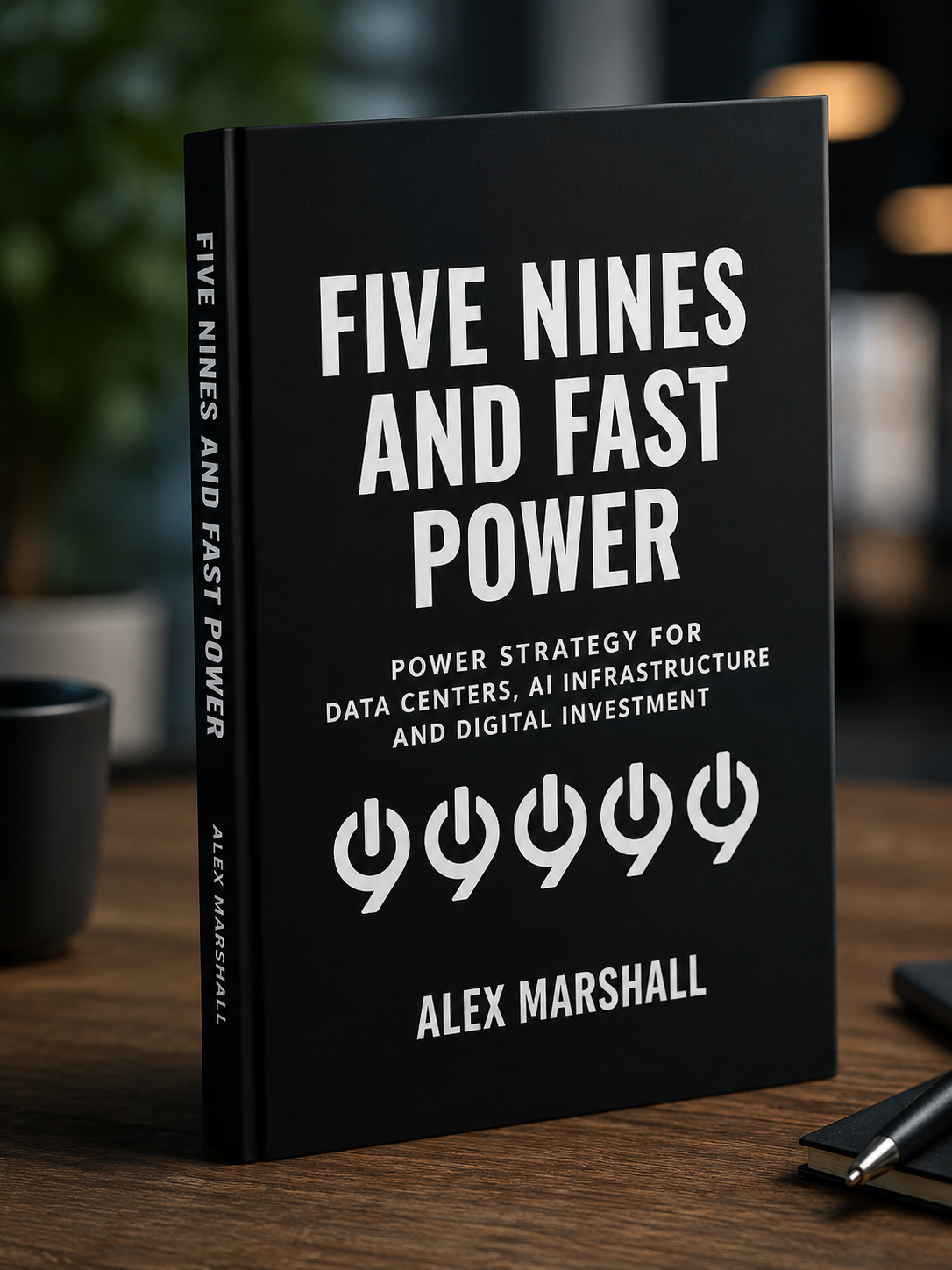
Five Nines and Fast Power
Power Strategies for Data Centers, AI Infrastructure and Digital Investment
The data center industry is facing a power problem it has not encountered before. Grid connections that once took months now take years. AI workloads are driving rack densities and continuous compute intensity far beyond what traditional infrastructure was designed to support. And the economic consequences of getting power strategy wrong - delays, downtime, stranded assets - are compounding with every quarter of accelerating investment.
Five Nines and Fast Power is a new book that addresses this directly. Drawing on observed behavior across markets rather than abstract models, it reframes how power decisions are understood, approached, and evaluated in environments where speed, reliability, and long-term resilience must be solved together, not traded off against each other.
Why Data Center Reliability Requires an Infrastructure Strategy
For much of the past decade, large-scale digital infrastructure operated under a stable assumption: reliable grid power would be available, with standby generation providing infrequent backup during outages. That assumption is now under sustained pressure.
Across multiple regions, the pace of data center growth is colliding with transmission constraints, interconnection delays, generation shortfalls, and permitting bottlenecks. In many cases, access to power, rather than land, capital, or even demand, has become the primary constraint on deployment. At the same time, AI workloads are redefining operational expectations. Higher rack densities, continuous compute intensity, and the commercial consequences of downtime are forcing a shift away from traditional backup philosophies toward systems designed for continuous operational resilience.
Reliability is no longer a technical attribute of backup systems. It has become a defining principle of infrastructure strategy itself.
Five Nines is a System Outcome
99.999% availability is often invoked as a target but rarely understood as an outcome. True five nines does not emerge from component specification. It is the product of system design created through the interaction of architecture, redundancy philosophy, control systems, operational strategy, maintenance practices, service capability, fuel resilience, and system flexibility over time. Each element contributes. None is sufficient in isolation.
In practice, resilient infrastructure depends on how effectively these systems perform under real operating conditions. Partial-load behavior, maintenance cycles, control system coordination, and the ability to respond dynamically to fluctuating demand all influence whether uptime targets are achieved in reality, not just in design. As AI infrastructure scales, the challenge is no longer simply how to install megawatts. It is how to construct integrated systems capable of sustaining resilience within an environment defined by constraint, variability, and continuous demand.
How Speed-to-Power Grid Delays Impact AI Investments
In many regions, grid connection timelines now extend deep into the latter part of the decade. Transmission expansion remains slow, permitting complexity persists, and supply chain constraints continue to affect generation deployment across multiple technologies. The strategic question has therefore changed.
It is no longer: how do we minimize emissions at the point of deployment? It is now: how do we deploy reliable power at speed while preserving the ability to improve performance over time?
This shift is fundamental. The energy transition is no longer unfolding under stable conditions. It is occurring against a backdrop of accelerating digital demand, rising electrification pressures, and increasing uncertainty in energy markets and policy frameworks. Infrastructure strategy must therefore move from fixed endpoints to phased evolution, designed not for a single operating condition, but for a sequence of transitions across the life of the asset.
Hybrid Power Architecture and On-Site Generation for Data Centers
The growing focus on on-site power is often presented as a binary choice between grid supply and fossil-based generation. In reality, modern infrastructure is moving in a different direction. Emerging architectures are increasingly hybrid, combining prime power generation, battery energy storage, CHP and CCHP integration, renewable inputs, and advanced control and optimization systems. In some cases, these systems are also designed to accommodate future fuel pathways and support active grid interaction.
The objective is not permanence. It is optionality. Infrastructure is increasingly being deployed to meet immediate capacity requirements while preserving the ability to evolve as technologies mature, economics shift, and carbon constraints tighten. This principle sits at the core of the Structured Transition Model, designing systems not for a fixed state, but for a sequence of transitions. The STM framework, developed through applied work across international energy markets, is explored separately here.
Reliability Under Real Operating Conditions
Infrastructure rarely operates under ideal conditions. Performance is shaped not by peak specifications but by behavior under variation, partial load, fluctuating AI demand, maintenance events, hybrid dispatch transitions, extreme weather, and wider grid instability. These dynamics place increasing importance on operational flexibility and system responsiveness.
Within distributed generation and hybrid microgrid architectures, this flexibility can offer meaningful advantages over large, centralized systems optimized for static operating assumptions. The interaction between generation assets, storage, and control systems becomes a critical determinant of overall resilience. Reliability, in this context, is not a design standard. It is an operational outcome, continuously maintained under changing conditions.
Lifecycle Thinking Matters More than Static Snapshots
A persistent weakness in infrastructure decision-making is the tendency to evaluate systems at a single point in time. Data center assets operate over decades. Over that period, grid carbon intensity will evolve, renewable penetration will increase, storage economics will improve, hydrogen and renewable fuels may emerge at commercial scale, policy frameworks and carbon markets will shift, cooling technologies will advance, and waste heat utilization will expand.
The question is therefore not how a system performs at commissioning. It is how it performs and adapts, over its lifetime. This creates a strong case for designing infrastructure capable of transition rather than optimizing for a static, short-term condition. The organizations that will sustain competitive advantage in AI infrastructure are not simply those that secure power fastest. They are those that secure power in a way that remains operationally and commercially sound across the full life of the asset.
Read also: The Temporal Trilemma
What the Book Covers
Five Nines and Fast Power examines how power decisions are actually made in data center development, where the frameworks work, where they break down, and what better infrastructure thinking looks like in practice. It addresses developers, operators, investors, and advisors navigating an environment where speed, reliability, and uncertainty coexist, and where the consequences of poor power strategy extend far beyond engineering into development timelines, capital efficiency, and long-term asset value.
The book draws on observed behavior across markets from established grid environments in North America and Europe to constrained and developing markets where distributed energy principles have been applied operationally for decades. It reflects how projects are actually delivered, where they encounter friction, and why some systems continue to perform while others struggle when assumptions break down.
Reviews
"The book does not offer a checklist. It explains why the existing checklists no longer describe the problem."
Aidan Turnbull, Managing Editor, Worldwide Independent Power September 2026, page 33.
Rating: ★★★★★
Questions and Answers
-
The book examines how power decisions are actually made in data center development, where conventional frameworks work, where they break down, and what better infrastructure thinking looks like in practice. It addresses the collision between accelerating AI-driven demand and the real-world constraints now shaping power access: long grid connection timelines, transmission bottlenecks, permitting complexity, and supply chain pressures.
-
The book is written for developers, operators, investors, and advisors working in data center and digital infrastructure, particularly those navigating environments where speed, reliability, and long-term uncertainty must be resolved together. It is equally relevant to those approaching these questions from an energy, finance, or strategic advisory perspective.
What does "five nines" actually mean? 99.999% availability, roughly five and a half minutes of downtime per year. The book treats this not as a specification target but as a system outcome: something that emerges from the interaction of architecture, redundancy, control systems, operational strategy, maintenance practices, and fuel resilience over time. No single component delivers five nines in isolation.
-
In many regions, grid connection timelines now extend years into the future. For AI infrastructure, where the commercial consequences of delay are compounding, access to power has become the primary constraint on deployment, ahead of land, capital, or demand. The strategic question has shifted from optimizing for lowest emissions at a fixed point in time to deploying reliable power at speed while preserving the ability to improve over time.
-
The STM is a framework for designing infrastructure not for a single operating state, but for a sequence of transitions across the life of an asset. Rather than optimizing for today's grid carbon intensity, technology mix, or fuel economics, it structures systems to accommodate evolving conditions: renewable penetration, storage economics, hydrogen pathways, carbon markets, cooling advances, as they mature over a decade or more.
Does the book address on-site and hybrid power architectures? Yes. Modern infrastructure increasingly combines prime power generation, battery energy storage, CHP and CCHP integration, renewable inputs, and advanced control systems, rather than choosing between grid supply and fossil-based backup. The book explores how these hybrid architectures are designed, how they perform under real operating conditions, and how they can be structured to accommodate future fuel and technology transitions.
-
The book draws on observed behavior across established grid environments in North America and Europe, as well as constrained and developing markets where distributed energy principles have been applied operationally for decades. The intent is to reflect how projects are actually delivered, where they encounter friction and why some systems continue to perform while others struggle when assumptions break down.