The Temporal Trilemma
The Missing Axis in the Energy Trilemma
by Alex Marshall
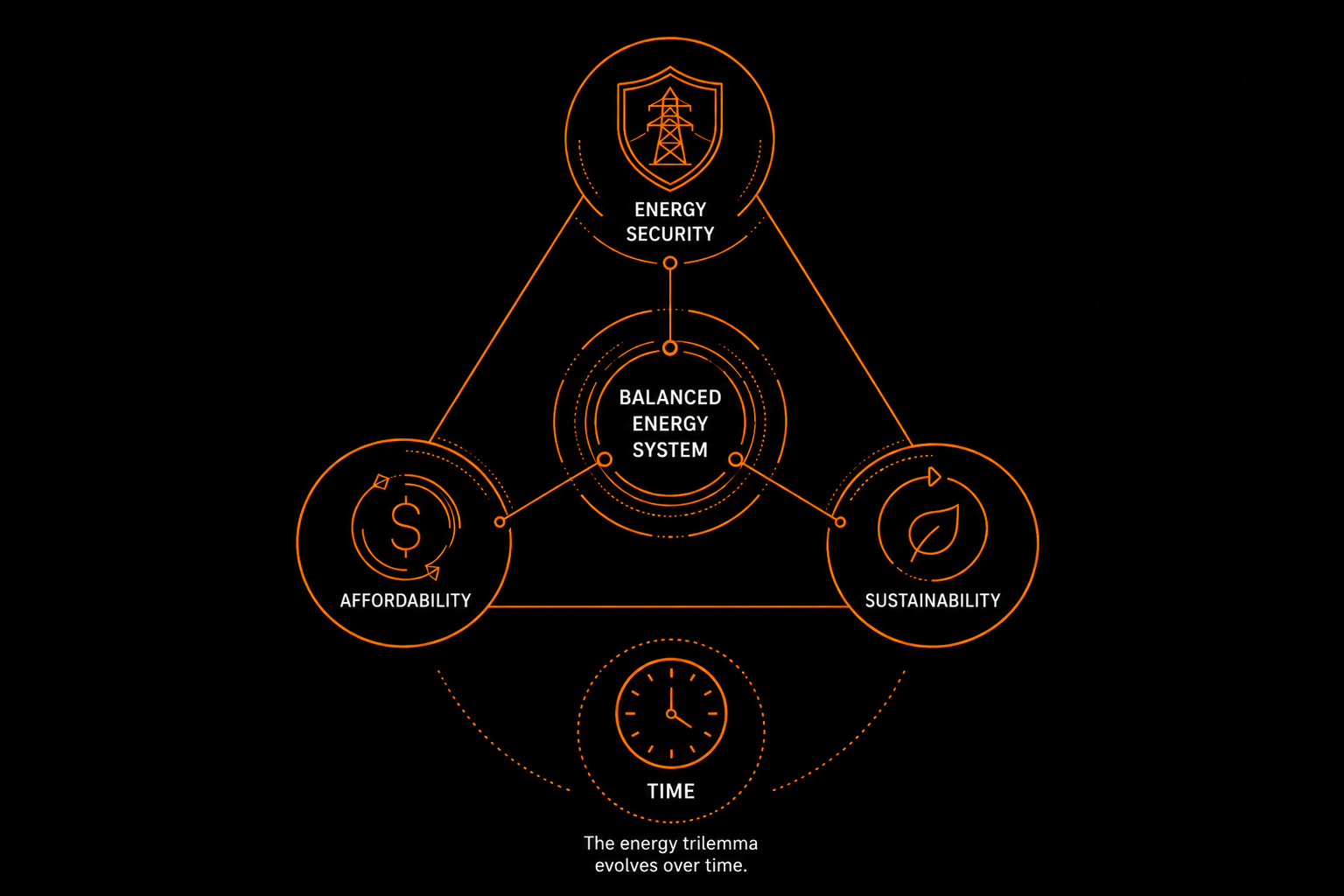
The energy trilemma has no time axis. For AI infrastructure, that is the axis that matters most.
The energy trilemma is usually drawn as a triangle. Three corners: security, affordability, and sustainability. The lesson it teaches is that you cannot fully satisfy all three at once, so you choose a balance and accept the trade-offs. The World Energy Council has measured national performance against those three dimensions since 2010, and the framework has become the default way the industry talks about energy choices.
A triangle is a useful picture. It is also a still picture. The thing it describes does not hold still.
Why Power Constraints are Limiting AI Data Center Infrastructure
It has been clear for a decade that ultimately power, not compute, would ultimately be the binding constraint on data center infrastructure, and onsite power would be a necessity. The consensus at the time was that chips and capital set the pace. They did not. The pace is set by how quickly you can put a megawatt where the load is. That shift, from compute as the scarce resource to power as the scarce resource, is what exposes the missing piece in the trilemma.
The trilemma tells you what to balance. It says nothing about when, or about how fast the balance can move, or about which direction it moves in. It has no time axis. For most of its working life that omission did not matter, because energy systems changed slowly. Policy moved in decades. Capacity moved in years. The balance point drifted, and an annual index was a perfectly good way to watch it drift.
How AI Growth Interrupted Traditional Grid Planning
AI infrastructure broke that assumption.
The International Energy Agency (IEA) reports that electricity demand from data centers rose 17 percent in 2025, against 3 percent growth in global electricity demand overall, and projects data center consumption to double by 2030 with AI-specific demand tripling. In the United Kingdom, Engineering & Technology reports that the proposed pipeline of data center projects could require 50 gigawatts, around 5 gigawatts more than the country's entire current peak demand.
This is not slow drift. It is a fast transient landing on a frame built for slow drift.
The balance moves backward, not just forward
Watch what the transient does to the three corners. Faced with a multi-year wait for a grid connection, developers are choosing speed and paying for it on the sustainability corner. Axios reports that roughly 30 percent of planned data center power capacity is now expected to be generated on-site, up from almost nothing a year earlier, that Chevron is building a natural gas plant dedicated to a single data center, and that operators are islanding sites, running them off-grid for years rather than waiting for the grid to catch up. The industry has a name for the priority driving all of this: speed to power, the time between project approval and energization. An industry framework launched by NEMA, ASHRAE, and the Pacific Northwest National Laboratory is built around shortening exactly that gap.
Read against the trilemma, this is a system giving ground on sustainability to buy time on security and delivery. Decarbonization progress that took a decade to accumulate can be set aside in a single procurement cycle. The balance does not only move. It moves backward.
That is the part the static triangle cannot show, and it is the part that matters most right now.
Naming the missing dimension: the Temporal Trilemma
So let me name it. I call this the “temporal trilemma”. The three corners do not change. Security, affordability, and sustainability are still the things in tension. What the temporal trilemma adds is the axis they travel along: time. This is not a fourth corner. Time is not another thing to balance against the other three. It is the dimension in which the balance moves, and it now moves fast enough, and reversibly enough, that ignoring it produces bad decisions.
Isn't it obvious the trilemma changes over time?
This is worth saying plainly, because the obvious objection is that everyone already knows the trilemma changes over time. They do. The World Energy Council has been evolving the framework for years, broadening what each corner contains and exploring concepts such as dynamic resilience. But those revisions enrich the corners. They make security and sustainability mean more. They answer the question of what to balance. They still do not answer the question of at what speed, and in which direction, the balance is moving, and whether you can respond before it moves again? That is a different question, and it is the operative one for anyone building infrastructure on an AI timescale.
Behind the meter, time works at more than one scale
There is a further point, and it is specific to the plants now going in behind the meter. When a site generates its own power, the carbon performance of that generation is not a fixed number. It changes with the grid it sits alongside, and it changes over the life of the plant.
Start with the short cycle. The carbon intensity of grid electricity moves through the day. It is low when wind and solar are running hard and high when the system leans on gas or coal to meet demand. A megawatt generated on-site at three in the morning, when the grid is clean, displaces clean power and compares badly. The same megawatt generated at the evening peak, when the grid is burning gas anyway, displaces dirty power and compares well. The asset did not change. The clock did. Score the sustainability corner as a single fixed value and you miss this entirely.
Then the long cycle. The plant deployed on day one is not the plant that has to run for twenty years. An engine installed to meet a speed-to-power requirement can take on a renewable fuel such as renewable natural gas or hydrogen later. Batteries can be added to shift output away from the hours when the grid is clean and toward the hours when it is not. Solar and storage can be layered on until the site is a microgrid, a local system that generates and balances its own power, rather than a single generator. What is installed changes over the life of the asset, and the way the site is run follows what is installed. The day-one choice sets a starting point. It does not set the destination.
Both of these are time. One runs in minutes. The other runs in years. Neither shows up on a triangle.
Managing Energy Grid Delays with a Structured Transition Model
If the problem is temporal, the answer is sequencing. This is the work the Structured Transition Model (STM) does. It sequences the asset over its life, deciding what to deploy now, what to run as a bridge, and what to converge on, and with storage in the mix it sequences within the day as well. Rather than picking a single balance and defending it, you meet today's speed requirement without foreclosing the sustainability requirement you will still have to meet later.
None of this makes the triangle wrong. Security, affordability, and sustainability are the right three corners. The point is narrower, and more useful: the trilemma is incomplete in exactly one dimension, and that dimension, time, is now the one doing the most work. Draw it as a still picture and you will keep being surprised by a system that refuses to stand still.
Five Nines and Fast Power
Making better decisions in the age of AI
Questions and Answers
-
It is the idea that an energy system has to balance three goals that pull against each other: security (keeping supply reliable), affordability (keeping it accessible), and sustainability (lowering its environmental impact). The World Energy Council has measured countries against these three dimensions since 2010. The core lesson is that improving one corner often costs you on another.
-
It is the same three corners with one addition: the axis of time. The standard trilemma is drawn as a static triangle and tells you what balance to strike. The temporal trilemma observes that the balance point moves, that it can now move quickly, and that it can move backward as well as forward. It is the trilemma understood as a system in motion rather than a snapshot.
-
That it changes is obvious. The rate and the reversibility are not. Energy systems used to move slowly enough that an annual review captured the drift. AI infrastructure introduced a fast transient, demand arriving on a timescale the planning system was never built to match. And the movement is not one-way. A decade of decarbonization progress can give ground in a single procurement cycle when speed becomes the binding constraint. That is the part the static framing misses.
-
Because AI infrastructure is where the transient is largest and fastest. The IEA expects data center electricity demand to double by 2030 and AI-specific demand to triple. Faced with multi-year waits for grid connection, developers are choosing speed: on-site generation, dedicated gas plants, off-grid islanding. Each of those is a decision to trade sustainability for delivery time. The trilemma cannot represent that trade, because it has no time axis. The temporal trilemma is built to.
-
No, and the distinction matters. A quadrilemma would add a fourth thing to balance. Time is not a thing to balance. Nobody optimizes for speed as an end in itself; speed is a constraint imposed by demand. Time is the axis the existing three corners move along. Adding it as a fourth corner would confuse a constraint with a goal. The temporal trilemma keeps three corners and adds the dimension they move through.
-
You sequence. Rather than picking a single balance and defending it, you decide what to deploy now, what to use as a bridge, and what to converge on, so that meeting today's speed requirement does not foreclose tomorrow's sustainability requirement. That sequencing discipline is what the Structured Transition Model sets out. The trilemma asks which balance. The temporal trilemma says the balance will move. Sequencing is how you stay ahead of it.