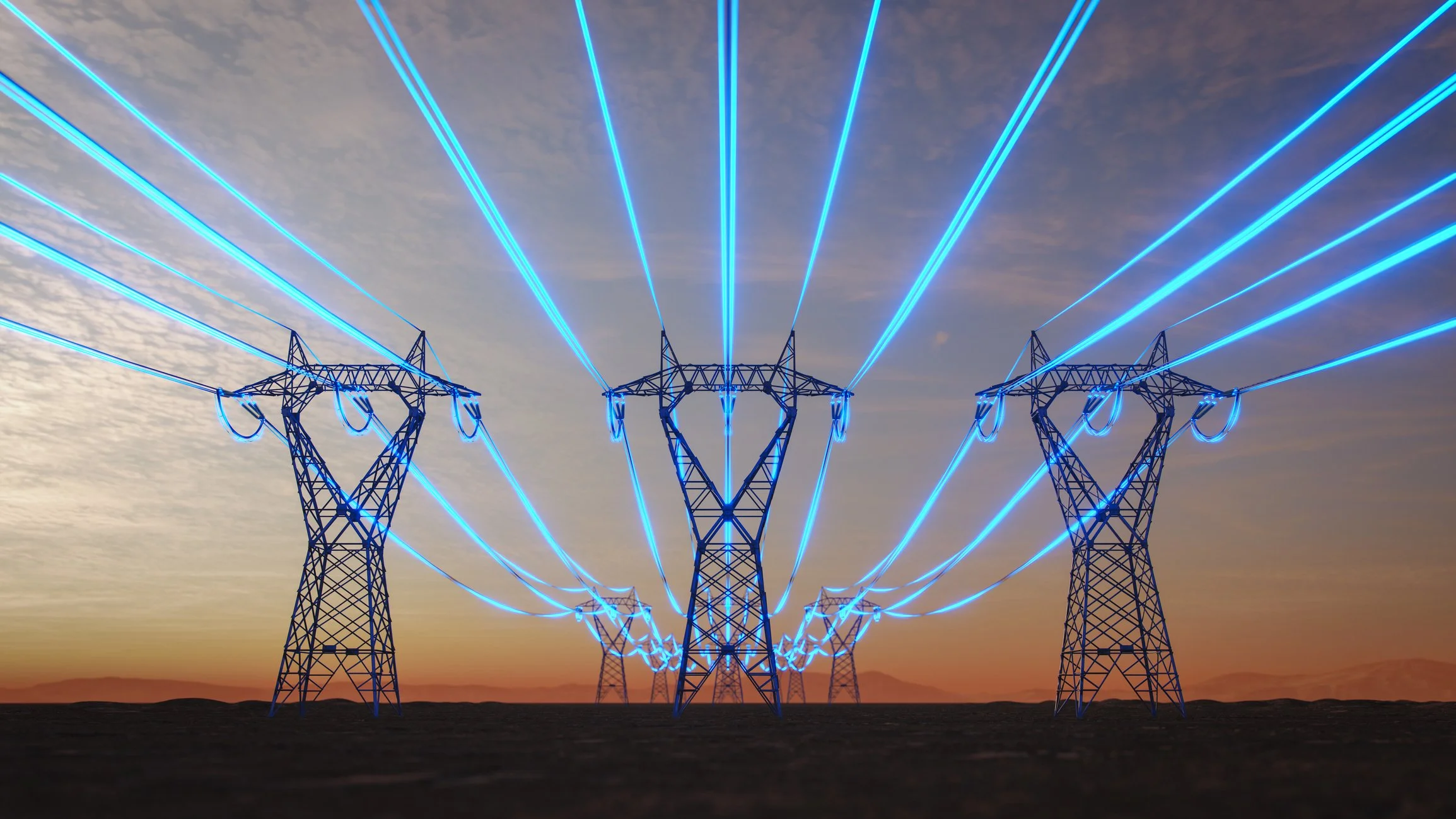
Power, Not Compute
The binding constraint on digital infrastructure is power, not compute. Chips can be designed and manufactured faster than the electricity to run them can be brought online and trusted. That is the conclusion. What follows is why it became true, because the claim only holds once you see the forces that produced it.
This did not happen suddenly. It is the result of separate developments, on the demand side and the supply side, that moved toward each other over more than a decade until they met. I have worked in the data center power conversation across that period and watched the two curves converge. The value of saying so is not the credit. It is that the convergence, not any single event, is the actual explanation, and most current commentary describes only the last step of it.
The demand side: how compute growth became electricity growth
For most of the history of computing, processing grew without a matching growth in power. Moore's Law, the observation that the number of transistors on a chip roughly doubles every two years, set the pace of processing. Alongside it ran a second effect, Dennard scaling, which held that as transistors shrank, the power each one drew fell in step. The two together meant performance could rise for decades without electricity demand rising in proportion. More compute did not mean much more power.
Dennard scaling broke down in the mid-2000s. Transistors kept shrinking, but the power each one drew stopped falling at the same rate. From that point, more performance was bought mainly through more cores running in parallel and more power drawn to run them. The hidden link between compute and electricity became a direct one. Every further step in processing now came with a step in power.
Artificial intelligence arrived on top of an efficiency curve that had already broken. It did not create the link between compute and electricity. It multiplied a link that was already there. The result is visible in the aggregate figures. The International Energy Agency puts data center electricity consumption at around 415 terawatt-hours in 2024, roughly 1.5 percent of global demand, and projects it to more than double to around 945 terawatt-hours by 2030, with AI as the primary driver. In the United States, data centers are projected to consume more electricity than the production of aluminum, steel, cement, and chemicals combined by the end of the decade. Demand growth that used to be an abstraction is now a line on the grid operator's forecast.
The supply side: firm power gets harder to draw
While demand was turning compute into electricity, the supply side was moving in the opposite direction. The dispatchable capacity a data center depends on, power that can be called on at any hour regardless of weather, was getting harder and more expensive to secure.
Coal and nuclear, the traditional sources of always-available baseload, have both been retiring across developed markets. The United Kingdom closed its last coal-fired power station in September 2024, becoming the first G7 nation to end coal generation entirely. Germany shut down its last nuclear plants in April 2023. The politics behind each decision differ, but the effect on the grid is the same: large blocks of firm, always-on capacity leaving the system faster than firm capacity is being built to replace them.
What is being added instead is largely intermittent. Wind and solar are now the cheapest sources of new generation in much of the world, but they are not dispatchable. They produce when the wind blows and the sun shines, not when the load calls. The mismatch has a well-known shape, the duck curve: solar floods the middle of the day, net demand on the rest of the system falls into a trough, then ramps sharply upward in the evening as the sun sets and demand peaks together.
Covering that evening ramp, and the shorter swings around it, requires peaking capacity, plant that can start quickly and follow a fast-moving load rather than run flat out around the clock. As intermittent generation has grown, the demand for that fast, flexible capacity has grown with it, and the technology meeting it has shifted. The role once held by the gas turbine has more recently and more often gone to the reciprocating gas engine, essentially a very large piston engine, which starts quickly, holds its efficiency across partial loads, and can be built up in modular blocks that follow a variable duty better than a single large turbine. The central problem of the modern grid is no longer generating enough energy across a year. It is balancing supply and demand hour by hour, and increasingly minute by minute.
Commercial and industrial (C&I) consumers, meaning large factories, campuses, and other major electricity users, responded to rising cost and falling reliability by moving toward onsite generation, producing some of their own power behind the meter rather than drawing all of it from the grid. That move ran into its own barrier. Connecting new generation, or a large new load, to the grid means passing through an interconnection queue, the study process that determines what grid upgrades a project requires and who pays for them. In the United States that queue has become a wall. More than 2,000 gigawatts of generation and storage were waiting for connection at the end of 2025, close to twice the entire installed US power fleet, and the median time from application to operation has stretched past four years. Even the parties trying to solve their own supply hit power, and the time to connect it, as the binding constraint.
The point of this section is a single one. Before data centers scaled, the supply of firm, dispatchable, connectable power was already the hard part.
The collision: data centers as concentrated load
Data centers arrive into that system as a particular kind of demand. They are very large, often hundreds of megawatts at a single site. They are concentrated, landing in one place rather than spread across a region. And they are largely inflexible, because the load cannot be interrupted without taking the service down. They are sited for cheap power, available land, and fiber connectivity, not for grid readiness, which means they frequently land in exactly the places least prepared to carry them.
So a fast-growing, concentrated, interruption-intolerant load is being placed onto a grid that is losing firm capacity, leaning on intermittent generation it must balance hour by hour, and already backed up by years at the point of connection. The data center is not the cause of the power constraint. It is the load that turns a chronic condition into an acute one.
What this sets up
Put the three forces together. Demand for electricity is accelerating now that compute and power have fused. Firm supply is shrinking and the grid is harder to balance. New supply and new load both wait years to connect. And the largest new loads are being placed on the thinnest parts of the system.
The binding constraint, therefore, is not processing capacity. It is the availability, the location, and above all the reliability of power, and the time it takes to bring firm supply online and trust it to run a load that cannot fail. Recognizing that power is the constraint is now the easy part. The field has arrived there. What matters is the work that follows from it, and that is the rest of this analysis.
Time is the real bottleneck. Speed to Power addresses it directly: how quickly firm, clean power can actually be delivered to a site, not just contracted for.
Under that time pressure, operators are forced to trade against their own commitments. The Temporal Trilemma sets out why speed, sustainability, and reliability cannot all be maximized at once.
The Structured Transition Model is the response to that trilemma, a way to sequence decarbonization so reliability is preserved and the gap between building supply and trusting it is closed on purpose rather than by accident.
Control Follows Assets applies the same logic at the level of the individual site and microgrid, where the way a system is governed should follow the assets it is built on and the direction they are heading.
Power, not compute, is where the analysis starts. It is not where it ends.
Five Nines and Fast Power
Making Better Decisions in the Age of AI


Questions and Answers
-
Power, not compute. Chips can be designed and manufactured faster than the electricity to run them can be brought online and trusted. Processing capacity scales with investment and engineering. Power scales with generation, grid connection, and the time it takes to prove a new supply is reliable. The slower of the two sets the ceiling, and it is power.
-
For decades it did not. Moore's Law set the pace of processing, and Dennard scaling meant the power each transistor drew fell as transistors shrank, so performance could rise without electricity rising in proportion. Dennard scaling broke down in the mid-2000s. After that, more performance came mainly from more cores and more power, so compute growth and electricity growth became the same thing. Artificial intelligence did not create that link. It multiplied one that was already there.
-
The dispatchable capacity a data center depends on is leaving the system. Coal and nuclear, the traditional sources of always-available baseload, have been retiring across developed markets. The United Kingdom ended coal generation in 2024 and Germany shut its last nuclear plants in 2023. What replaces them is largely intermittent wind and solar, which produce when the weather allows rather than when the load calls. The grid's central problem is no longer producing enough energy across a year but balancing supply and demand hour by hour.
-
Because new capacity cannot connect quickly. Any new generation or large new load must pass through an interconnection queue, the study process that decides what grid upgrades are needed and who pays for them. In the United States more than 2,000 gigawatts of generation and storage were waiting to connect at the end of 2025, close to twice the entire installed US fleet, and the median wait from application to operation has stretched past four years. Even commercial and industrial users trying to build their own onsite power hit the same wall. The shortage is not only megawatts. It is the time to connect them.
-
They are large, often hundreds of megawatts at a single site, concentrated in one location, and largely inflexible, because the load cannot be interrupted without taking the service down. They are sited for cheap power, land, and fiber rather than grid readiness, so they often land where the grid is least able to carry them. A fast, concentrated, interruption-intolerant load placed on a system already short of firm capacity and backed up at connection turns a chronic condition into an acute one.
-
The recognition is now the easy part. The work is what follows from it. Time is the real bottleneck, which is the subject of Speed to Power. Under time pressure, speed, sustainability, and reliability cannot all be maximized at once, which is the Temporal Trilemma. The Structured Transition Model sequences decarbonization so reliability holds and the gap between building supply and trusting it is closed on purpose. Control Follows Assets applies the same logic at the level of the individual site and microgrid.