AI Infrastructure Is Entering Its Reality Phase. Power Will Decide the Winners.
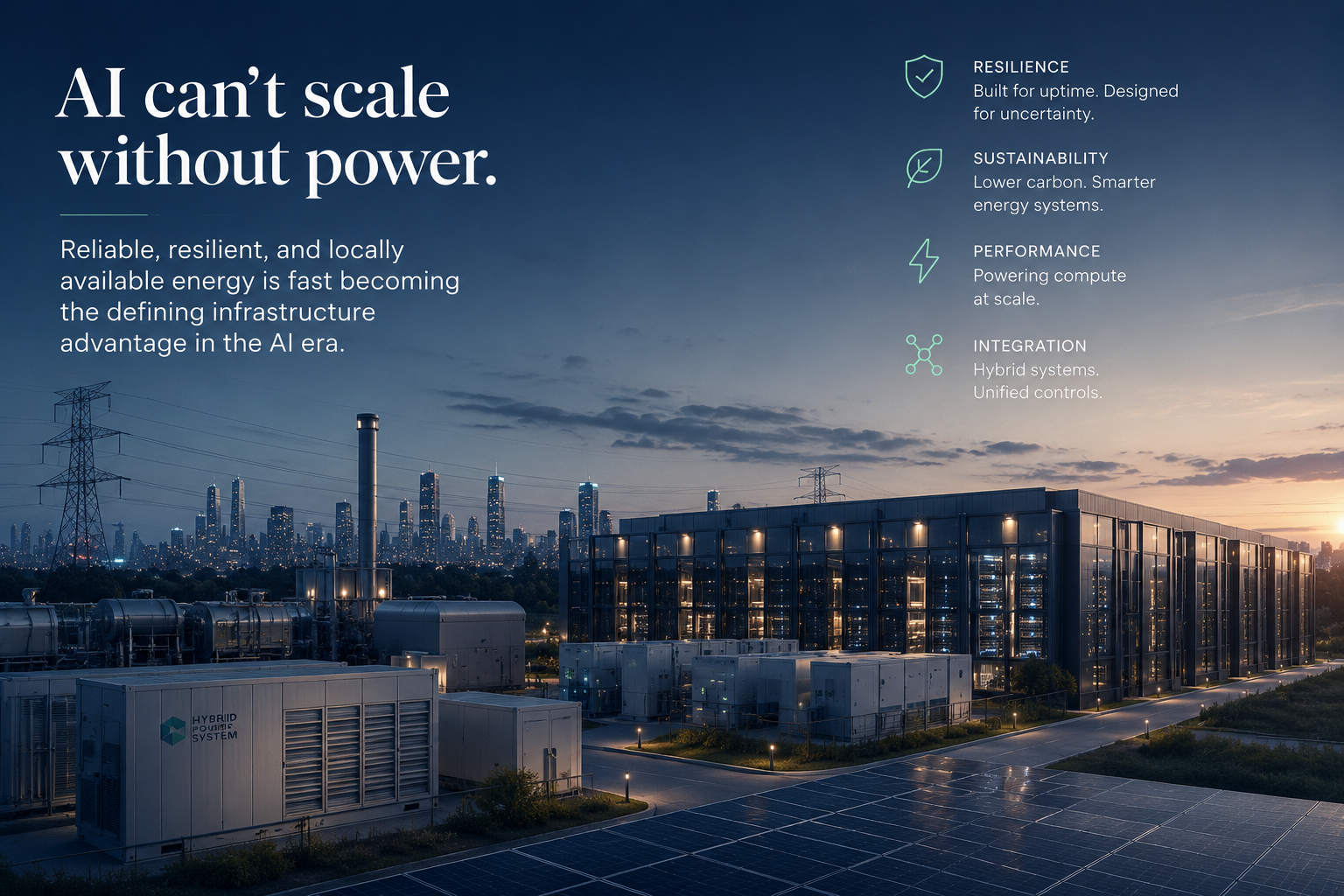
For the past two years, artificial intelligence has largely been discussed through the lens of software, valuations, and semiconductor performance. Markets have oscillated between enthusiasm and skepticism almost weekly. Capital continues to flood into AI infrastructure at extraordinary speed, while concerns around oversupply, monetization, and long-term returns are beginning to surface just as quickly. But beneath the volatility sits a much more durable reality - AI is not simply a software story. It is an infrastructure story and infrastructure obeys physical constraints.
The next phase of AI development will not be determined solely by model capability or GPU availability. Increasingly, it will be shaped by access to reliable power, grid capacity, cooling infrastructure, permitting timelines, and the ability to deploy energy systems fast enough to support accelerating computational demand. This is where the conversation becomes materially different from previous digital growth cycles.
AI workloads are dramatically increasing power intensity within data centers. Rack densities that once sat comfortably below 10 kW are now moving toward 30 kW, 50 kW and beyond in certain high-performance AI environments. These facilities are operating continuously, often at far higher utilization rates than traditional enterprise infrastructure. The consequence is that electricity is no longer a background utility for digital infrastructure. It has become a primary strategic constraint.
Across major markets, grid limitations are now emerging as one of the defining bottlenecks for AI deployment. Utilities in parts of North America and Europe are facing increasing pressure from transmission congestion, interconnection queues, aging infrastructure, and the sheer speed at which new capacity is being requested. In some regions, developers are encountering multi-year delays simply to secure grid access.
This is one reason why distributed and on-site energy systems are moving from niche solutions into mainstream infrastructure strategy. Microgrids, hybrid power systems, battery energy storage, combined heat and power, and flexible gas-engine generation are increasingly being evaluated not merely as backup systems, but as deployment enablers. In many cases, they are becoming essential tools for reducing dependency on constrained grids and accelerating speed-to-power for new developments. Importantly, this is not simply about resilience during outages. It is about operational certainty.
For hyperscalers, colocation providers, and AI-focused developers, downtime carries immediate commercial consequences. But equally significant is the risk of delay. A data center without available power is not a stranded asset in theory; it is stranded in practice. As AI infrastructure competition intensifies, the ability to energize facilities rapidly may become as commercially important as the computing architecture itself.
This is why the most sophisticated operators are increasingly approaching energy infrastructure through a systems lens rather than a single-technology lens. The long-term direction of travel remains toward lower-carbon and increasingly optimized energy systems. But the practical pathway matters. Infrastructure designed today must balance immediate reliability requirements with the flexibility to evolve over time as grids decarbonize, storage technologies mature, renewable penetration increases, and new fuels become commercially viable. That creates a very different infrastructure challenge than many simplistic “grid versus generation” debates imply.
The future is unlikely to belong to purely centralized or purely isolated systems. Instead, the market is moving toward increasingly hybridized architectures where grids, local generation, storage, thermal management, and intelligent controls work together as integrated systems. In this environment, resilience and decarbonization increasingly become complementary objectives rather than opposing ones.
Well-designed hybrid infrastructure can improve efficiency, reduce emissions intensity, enhance grid stability, and accelerate deployment simultaneously. Data centers themselves may also evolve into more active participants within wider energy ecosystems supporting local grid flexibility, participating in balancing services, and helping stabilize increasingly complex electricity networks.
This is ultimately why the current market volatility around AI may prove less important than many assume. Speculative capital will inevitably fluctuate. Some business models will fail. Valuations will reset. That is normal during major technological transitions. But the underlying infrastructure requirement remains. AI cannot scale without power.
The organizations likely to create the most durable long-term value may not simply be those building the most advanced models, but those capable of securing, integrating, and operating resilient energy infrastructure at scale. Because while financial markets move in cycles, infrastructure operates on decades. In the end, molecules and electrons still determine what is physically possible.
Frequently Asked Questions
Why is AI development an infrastructure story as much as a software story?
AI development requires physical infrastructure that obeys physical constraints. Model capability and GPU availability determine what AI can do in theory. Access to reliable power, grid capacity, cooling infrastructure, permitting timelines, and the ability to deploy energy systems fast enough to support accelerating computational demand determine what AI can do in practice. The next phase of AI development will increasingly be shaped by these physical constraints rather than by software or semiconductor performance alone. Capital markets move in cycles, but infrastructure operates on decades, and the underlying power requirement for AI at scale does not disappear during periods of market volatility.
How are AI workloads changing power density requirements in data centers?
AI workloads are dramatically increasing power intensity within data center facilities. Rack densities that once sat comfortably below 10 kilowatts are now moving toward 30 kilowatts, 50 kilowatts, and beyond in certain high-performance AI environments. These facilities operate continuously at far higher utilization rates than traditional enterprise infrastructure. The consequence is that electricity is no longer a background utility input for digital infrastructure. It has become a primary strategic constraint shaping where facilities can be built, how quickly they can be energized, and what their long-term operational economics look like.
What is causing grid constraints for data center developers across North America and Europe?
Grid limitations are emerging from several simultaneous pressures. Transmission systems are experiencing congestion as electrification across transportation, heating, and industrial sectors increases total demand. Interconnection queues are lengthening as the volume of new generation and load connection requests exceeds the pace at which utilities can process and fulfill them. Aging infrastructure in many regions requires significant capital investment before it can support higher load densities. And the speed at which AI infrastructure developers are requesting new capacity is outpacing the planning and construction timelines of traditional grid expansion. In some regions developers are encountering multi-year delays simply to secure grid access.
What is the commercial risk of power delay for AI infrastructure developers?
A data center without available power is not a stranded asset in theory. It is stranded in practice. Large-scale compute infrastructure cannot generate value until it is energized, and for AI infrastructure developers operating in an intensely competitive environment, delay carries direct financial exposure. As AI infrastructure competition intensifies, the ability to energize facilities rapidly may become as commercially important as the computing architecture itself. This is why speed-to-power has moved from a secondary consideration to a primary strategic variable in AI infrastructure development decisions.
Why are hybrid energy architectures becoming the dominant model for AI data center power?
The future of AI infrastructure power is unlikely to belong to purely centralized grid-dependent systems or purely isolated onsite generation. The market is moving toward hybridized architectures where grids, local generation, storage, thermal management, and intelligent controls work together as integrated systems. Well-designed hybrid infrastructure can improve efficiency, reduce emissions intensity, enhance grid stability, and accelerate deployment simultaneously. Resilience and decarbonization become complementary objectives rather than competing ones. Infrastructure designed today must balance immediate reliability requirements with the flexibility to evolve as grids decarbonize, storage technologies mature, renewable penetration increases, and new fuels become commercially viable.
Why may the organizations that control energy infrastructure create more durable value than those building AI models alone?
Speculative capital fluctuates. Some AI business models will fail. Valuations will reset. That is normal during major technological transitions. But the underlying infrastructure requirement remains regardless of which models or applications ultimately succeed. The organizations most likely to create durable long-term value may not simply be those building the most advanced models, but those capable of securing, integrating, and operating resilient energy infrastructure at scale. Because while financial markets move in cycles, infrastructure operates on decades. Molecules and electrons ultimately determine what is physically possible, and AI cannot scale without power.