Why Speed-to-Power Is Reshaping Data Center Infrastructure
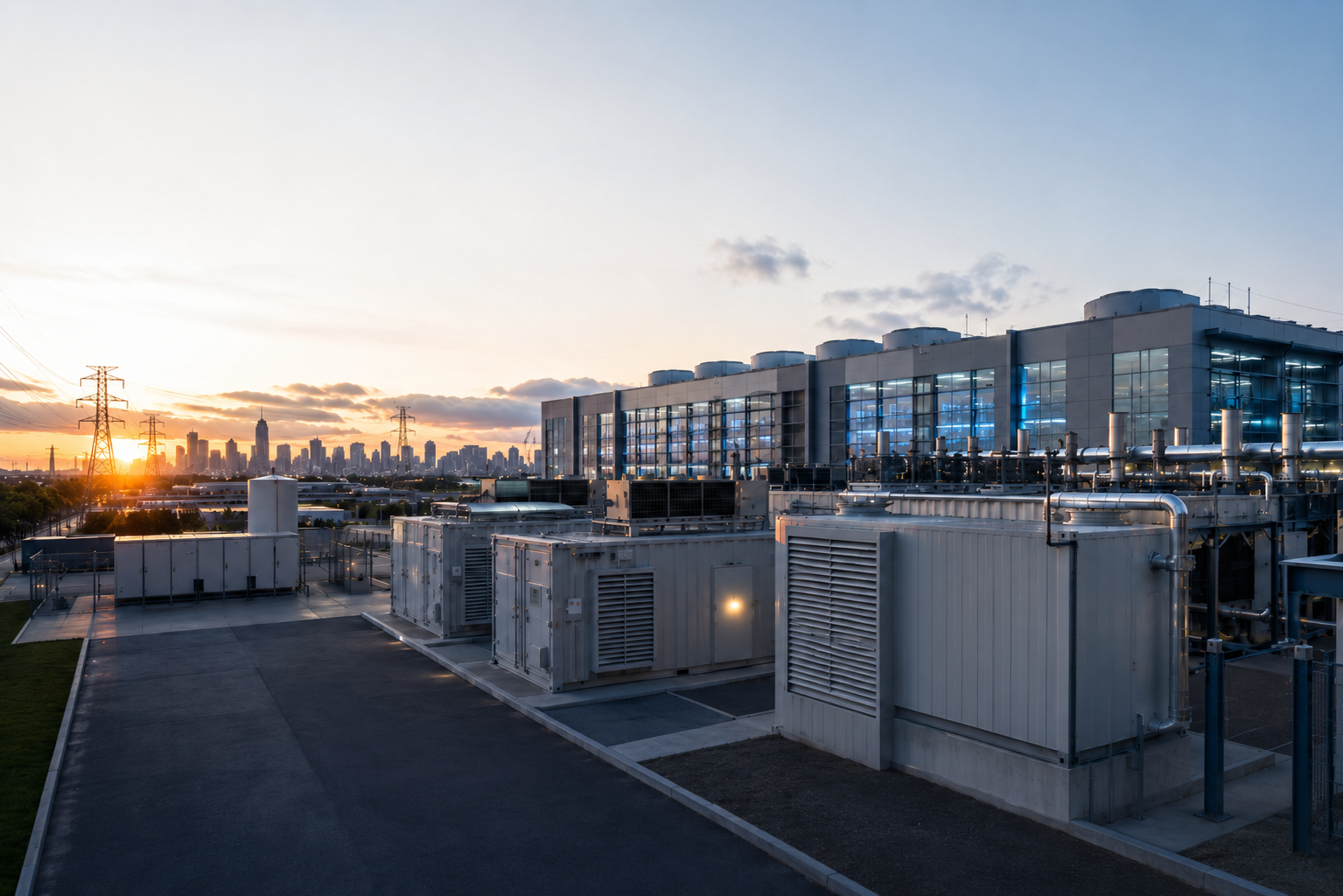
AI growth is turning power availability from a utility assumption into a strategic infrastructure constraint.
Why Speed-to-Power Is Reshaping Data Center Infrastructure
For most of the past decade, energy strategy in the data center sector focused on a familiar set of priorities: renewable energy procurement, long-term efficiency improvements, sustainability commitments, and carbon reduction targets. Those objectives remain important. But another factor has rapidly moved to the center of infrastructure decision-making, and it is changing the conversation in ways that are not yet fully reflected in how projects are planned, funded, or evaluated.
That factor is speed-to-power.
Across major markets, the limiting constraint for AI infrastructure deployment is increasingly no longer capital, computing hardware, or land availability. It is access to reliable electrical power within commercially acceptable timelines. Utility interconnection delays now extend years into the future across parts of North America and Europe. Transmission congestion, permitting challenges, substation constraints, transformer shortages, and broader grid infrastructure limitations are creating a widening gap between the pace of AI investment and the pace at which traditional electrical infrastructure can expand.
This is changing behavior across the industry in ways that are more fundamental than they might first appear.
From resilience enhancement to deployment enabler
Historically, distributed energy systems in commercial and industrial markets were positioned primarily as resilience enhancements: reducing exposure to outages, improving energy efficiency, supporting sustainability objectives, or providing operational flexibility during periods of grid instability. That framing still applies, but it no longer captures the full picture.
In many cases, distributed energy infrastructure is now becoming a deployment enabler. The distinction matters. The objective is no longer merely to improve resilience around an existing utility connection. Increasingly, infrastructure is being deployed ahead of, alongside, or partially independent from the grid in order to accelerate operational readiness. For AI data center developers operating in constrained markets, onsite generation, hybrid microgrids, battery energy storage, and flexible distributed energy architectures are moving from specialist considerations into mainstream infrastructure planning.
The permanence problem
Speed-to-power creates a challenge that is easy to overlook in the urgency of deployment. Infrastructure deployed rapidly during periods of market pressure often remains operational for decades. Temporary infrastructure has a habit of becoming permanent infrastructure.
That means decisions made today cannot be evaluated solely on immediate energisation timelines. They must also account for long-term operational flexibility, lifecycle efficiency, emissions trajectory, fuel adaptability, and integration potential with future grid evolution. A power system deployed without consideration for future transition risks becoming operationally constrained or economically inefficient well within its working life. Equally, waiting indefinitely for idealized grid conditions may prevent deployment altogether.
The challenge is therefore not choosing between resilience and sustainability. It is preserving optionality while maintaining operational credibility today.
A different way of thinking about reliability
The most effective infrastructure strategies are those that balance three requirements simultaneously: how rapidly can capacity be deployed, how resilient is the resulting architecture, and how can the system evolve toward lower emissions over time. These questions are increasingly interconnected rather than sequential.
This also changes how reliability itself needs to be understood. Historically, uptime discussions focused heavily on component-level redundancy and the pursuit of five nines availability. But high availability is ultimately an architectural outcome rather than a single equipment specification. Fuel strategy, modularity, controls integration, maintenance philosophy, thermal management, and system integration all contribute to long-term resilience in ways that point-in-time equipment decisions cannot capture alone.
Hybrid approaches combining grid supply, onsite generation, energy storage, thermal recovery, and advanced control systems are likely to become the dominant architecture precisely because they address all three requirements without forcing a choice between them.
The broader implication
For much of the past decade, competitive advantage in digital infrastructure was primarily a computing and software question. Increasingly, it may depend just as heavily on the ability to secure, deploy, and evolve resilient power infrastructure at scale. The organisations likely to lead the next phase of AI infrastructure development are not simply those with the most advanced models or the deepest capital reserves. They are those that can solve the power problem: reliably, quickly, and with enough flexibility to adapt as conditions change.
The AI race is becoming an infrastructure race. Power is where it will be won or lost.
Five Nines and Fast Power
Frequently Asked Questions
What is "speed-to-power" and why does it matter for AI data centers?
Speed-to-power refers to how quickly a data center can access reliable electrical capacity and get operational. As AI infrastructure demand has surged, securing power within commercially viable timelines has become the single biggest bottleneck, overtaking capital, land, and hardware as the primary constraint on deployment.
Why are utility connections taking so long?
Utility interconnection queues in North America and Europe now stretch years into the future. The delays stem from a combination of transmission congestion, substation capacity limits, transformer supply shortages, and lengthy permitting processes, none of which were designed to accommodate the pace of AI-driven infrastructure growth.
What alternatives are data center developers turning to?
Rather than waiting for grid connections, many developers are deploying onsite generation, battery energy storage systems, hybrid microgrids, and flexible distributed energy architectures. These solutions allow facilities to become operational faster, either independently of the grid or alongside a partial utility connection.
Isn't this just a temporary workaround until the grid catches up?
Not necessarily. Infrastructure built quickly under market pressure tends to remain in place for decades. That makes it critical to plan these systems with long-term factors in mind, including emissions trajectories, fuel flexibility, lifecycle costs, and the ability to integrate with future grid developments, rather than treating them as short-term fixes.
Does prioritising speed mean sacrificing sustainability goals?
It does not have to. The real challenge is preserving optionality: building systems that can operate reliably today while remaining adaptable as cleaner energy sources and better grid infrastructure become available. Hybrid architectures that combine multiple energy sources are well suited to achieving both.
What does this mean for how companies should think about competitive advantage?
Organisations that can solve the power problem, securing capacity quickly, building resilient systems, and maintaining flexibility to evolve, are likely to have a structural edge in the AI infrastructure race. Technical capability and capital alone are no longer sufficient. Energy infrastructure has become a core strategic differentiable.