The Thinking Behind the Structured Transition Model
A framework for deploying and evolving power infrastructure in the digital economy
Developed and authored by Alex Marshall, Clarke Energy, a Rehlko Company
I have been arguing that power, not compute, would become the binding constraint on digital infrastructure since 2017, years before the AI boom made it obvious. That conviction did not come from forecasting. It came from having watched infrastructure cycles play out before.
In the early waste-to-energy years, and across two decades of distributed generation, I saw a pattern repeat. A novel demand emerges. Capital moves fast. New technologies are deployed to meet it at speed. And a significant share of those assets are stranded or compromised within years, not because the technology failed, but because it was committed to a single end-state in a world that refused to hold still. The grid moved. Fuel economics moved. Policy moved. The systems that survived were the ones anchored in proven, adaptable assets and designed to change.
The AI data center boom is now running the same playbook, and making the same mistake. Right now, investors see one thing: speed to power. Not the fifteen-to-twenty-five year life of the asset they are funding. Not the environmental exposure building around it. Not the political risk that arrives the moment a region's load growth becomes a public issue. Speed is necessary, but speed alone, with no pathway to what comes next, is how you strand capital. And the pressure is only moving in one direction: climate change is accelerating, public pushback against data centers is intensifying, and developers without a credible decarbonization pathway will find that the license to build does not last the life of the building.
This is why novel technology has to be anchored in what is proven, long-lived, and adaptable. The lesson from every prior cycle is the same: the winners are not the ones who optimized for the moment. They are the ones who stayed flexible enough to outlast it.
That experience shaped a systems-level perspective grounded in three principles: reliability, optionality, and transition. Speed-to-power, resilience, and decarbonization are not competing objectives to be traded against one another. They are priorities that can be engineered to evolve together, if the infrastructure is designed for adaptation rather than permanence.
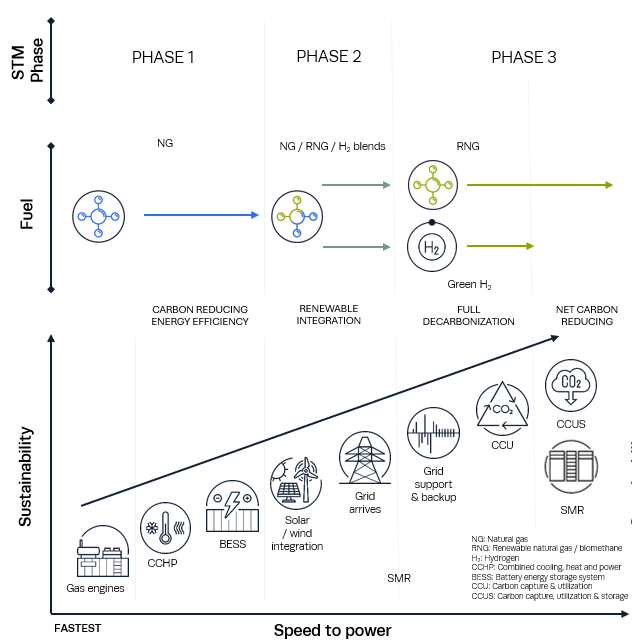
This thinking led to the Structured Transition Model: a framework for deploying power that meets immediate reliability requirements while retaining the ability to improve as technologies mature, economics shift, and carbon constraints tighten. It treats infrastructure not as a fixed endpoint, but as a managed trajectory.
The full framework, with supporting analysis, lifecycle carbon modelling, and sector applications, was launched at DataCloud Cannes 2026, and has been published by Rehlko.
You can download the full white paper below.
https://www.rehlko.com/whitepaper-structured-transition-model-for-ai
Questions and Answers
Q: What is the core mistake investors are making in the AI data center boom right now?
Optimizing for speed to power without accounting for the 15 to 25 year life of the asset they are funding. Speed is necessary, but speed committed to a single technology or end-state, with no pathway to adapt as the grid, policy, and carbon constraints evolve, is how capital gets stranded. The same pattern played out in waste-to-energy and distributed generation. Assets that locked in a fixed architecture were compromised not because the technology failed, but because the world around them kept moving.
Q: What is the Structured Transition Model?
A framework for deploying power infrastructure that meets immediate reliability requirements while retaining the ability to improve as technologies mature, economics shift, and carbon constraints tighten. Rather than treating infrastructure as a fixed endpoint, the model treats it as a managed trajectory, engineered for adaptation rather than permanence. The full framework, including lifecycle carbon modeling and sector applications, has been published by Rehlko as a white paper and dedicated microsite.
Q: Are speed to power, resilience, and decarbonization competing priorities?
No, and that framing is part of the problem. They are often presented as a three-way trade-off, which leads developers to defer decarbonization as a future problem. The argument here is that they are priorities that can be engineered to evolve together, provided the infrastructure is designed for adaptation from the outset. The constraint is not which objective to sacrifice. It is whether the architecture is flexible enough to serve all three over its operating life.
Q: What risks are data center developers underestimating beyond energy supply?
Two in particular: environmental exposure and political risk. As climate change accelerates and the physical risks to infrastructure increase, assets designed without climate resilience built in face growing operational vulnerability. And as load growth becomes a visible public issue in regions with data center concentration, the social and regulatory license to build does not automatically extend through the life of the building. Developers without a credible decarbonization pathway are accumulating both types of risk simultaneously.
Q: What does prior infrastructure experience tell us about the winners in these cycles?
Across early waste-to-energy and two decades of distributed generation, the pattern is consistent: the winners were not the ones who optimized for the moment. They were the ones who anchored in proven, long-lived, adaptable assets and built systems designed to change as conditions changed. The losers committed to a single end-state at speed. A significant share of those assets were stranded within years, not through technology failure, but through inflexibility in a world that refused to hold still.