The Names on the Page
What I said about anaerobic digestion as a founder member of ADBA, and what actually happened.
In September 2009, the Anaerobic Digestion and Biogas Association, now the Anaerobic Digestion and Bioresources Association, was founded by Lord Redesdale and ten founder member companies. Clarke Energy was one of them and I was the person named for Clarke Energy. ADBA acknowledged the founding members and published a short interview with me on its founders page.
For years I described that as a company achievement. It was, but the framing was always slightly wrong.
When a trade association launches it has no track record. No data, no publication history, no relationships in Whitehall, no seat at any table. What it has is a list of members. So the companies go first. Ten names, each carrying its own decades of engineering, gave the new organization something it could not generate on its own at that time: credibility. A civil servant will meet an association backed by ten operating businesses. They will not meet an idea.
Logos do not draft consultation responses. Letterheads do not sit through four hours of a working group arguing about digestate quality protocols. The credibility was lent by the companies. The work was done by people.
The founders page has since come off ADBA's live site. I found the interview in a web archive. Reading my own answers back after seventeen years is a more useful exercise than remembering that I was on the list.
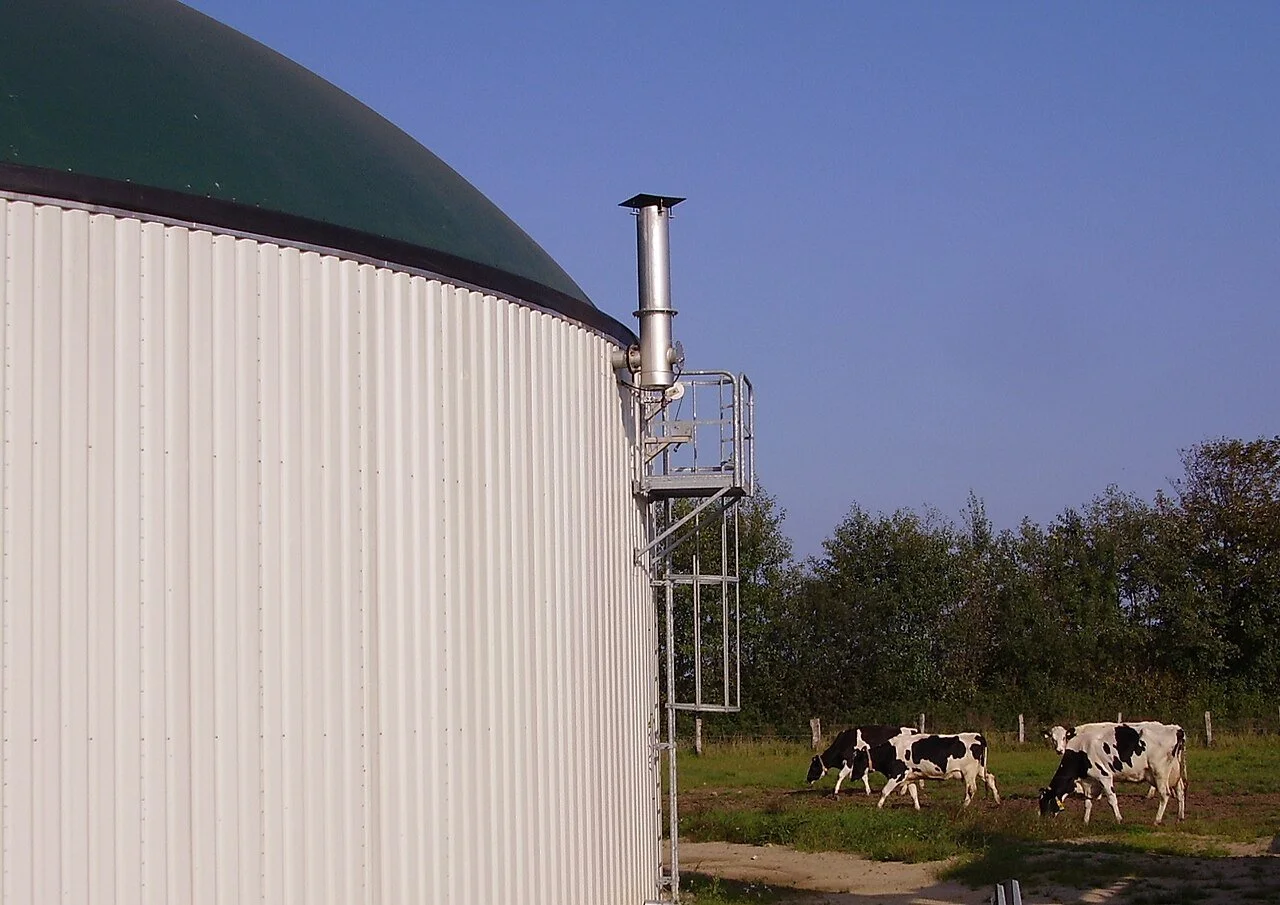
Photograph I took at an agricultural biogas plant in Germany in 2007 and uploaded to Wikipedia. Nineteen years later it is still illustrating the anaerobic digestion article. https://en.wikipedia.org/wiki/Anaerobic_digestion
What I got right in 2009: capital cost versus through-life cost
Asked about the future of AD, I said the challenge in the UK related to "the current focus on lowest capital cost solution rather than through life costs of the anaerobic digestion plant, which was also the case in the early days of the UK landfill industry." I expected the sector to mature past it.
I still think the diagnosis was correct. I was too optimistic about the cure.
The lowest-capex bias is not a phase an industry grows out of. It is a pattern I have watched repeat across biogas, agricultural biogas, pollution remediation and waste management infrastructure. It happens whenever an asset class is financed before it is understood. Underwriters price what they can compare, and capital cost is the easiest number to compare. Availability, operating hours, parasitic load, feedstock flexibility, maintenance regime and actual output over fifteen years are harder, so they get discounted.
Plants get built to a price. Many of the plants built to a low capex budget underperform, and that underperformance surfaces in the operating data over the following years. Generation assets then get ripped out and replaced. Buy cheap, buy twice. The asset owner is left holding a replacement cost nobody underwrote, which is why life-of-asset cost matters more to an investor than initial capex.
This is not a technology problem. It is a measurement problem, and measurement problems persist far longer than technology problems.
What I got wrong in 2009: 1,100 UK AD plants by 2020
Asked where I wanted ADBA to be in five years, I said I wanted it setting out the method of delivery for "the proposed target of 1,100 anaerobic digestion facilities by 2020."
The UK did not get there. The country has somewhere around 700 operational AD plants today, six years past that deadline. ADBA is now calling for 1,000 new plants by 2030, which is roughly the same ambition restated a decade later.
I do not think the target was foolish. The feedstock resource was there and still is. The technology worked when it was specified appropriately. The policy support existed. I treated deployment as the hard part, and it was not. The hard part was the thing I had already identified in the previous answer and then failed to connect to the forecast.
A sector that competes on capital cost builds a fleet whose average performance disappoints its own investors. Disappointed investors slow the pipeline. The build rate is downstream of the quality problem.
I had both halves of that in the same interview and did not put them together.
Why this still matters
The other thing I said in 2009 was that what motivated me was traveling and seeing how different countries approached the same problem, comparing anaerobic digestion in the UK, France, India and Australia against captive gas power in Nigeria. That is not a personality note. It is a method. You see structural patterns by watching the same problem get solved badly in several places at once.
Here is the pattern I am watching now.
Data center developers are not primarily cost constrained. They are time constrained, and speed to power does the same damage that price did in AD, for exactly the same reason: it is the number that is easy to compare. Projects are ranked on cost per megawatt and, more decisively, on speed to energization. Through-life performance is harder to compare, so it gets discounted. Real availability under load. Fuel flexibility as gas and grid pricing move. Maintenance regimes over a fifteen-year asset life. What the site does when the interconnection queue moves against it.
The capital is arriving faster than the vocabulary for evaluating it.
The AD sector took fifteen years to learn that lesson and is still paying for it. Data center power is running the same play with two orders of magnitude more capital and far less time to correct.
That is why the definitional work matters, and why I spend time in the iMasons Climate Accord Power Working Group, the Cogen World Coalition and the World Biogas Association rather than treating them as networking. Trade bodies look like overhead. They are the mechanism by which a sector learns to describe itself, and nothing gets financed properly until it can be described properly. In 2009 I said the establishment of ADBA as a dedicated professional group had been invaluable for the industry. That was right, and it was right for a reason I could not fully articulate at the time.
The page is gone
There is something appropriate about the founder members page disappearing. Founding documents matter enormously for about three years, and then the institution outgrows them. ADBA has done exactly that. It now represents over 300 organizations, and the World Biogas Association grew out of it, where I sit as a Council Member.
But the scorecard is worth keeping. Institutions lend credibility. Individuals earn it, and they earn it by being specific enough to be wrong in public and then saying so.
Alex Marshall was named as Clarke Energy's founder member representative to the Anaerobic Digestion and Biogas Association, established September 2009 by Lord Redesdale and ten founder member companies. Interview source: ADBA founder members page, archived April 2017.
Questions and Answers
Source text: Alex Marshall's 2009 ADBA founder member interview The following Q&A was published on the Anaerobic Digestion and Biogas Association founder members page in 2009, where Alex Marshall was named as Clarke Energy's founder member representative. The page is no longer on ADBA's live site. It is reproduced here from a web archive capture dated April 2017.
What are you most passionate about? What motivates you? "I get great pleasure from travelling and seeing how different countries and cultures tackle the requirements for sustainable energy supplies, whether via the application of anaerobic digestion for the production of renewable power in the UK, France, India and Australia, or the utilisation of low-carbon, clean-burning natural gas in Nigeria for captive power plants."
What do you think the future of AD looks like? Give us the positives and the negatives. "Anaerobic digestion will play a significant contribution to the world's future global energy mix. Challenges in the UK relate to the current focus on lowest capital cost solution rather than through life costs of the anaerobic digestion plant, which was also the case in the early days of the UK landfill industry. As the industry matures and knowledge grows we believe this will also change and the focus on quality will gain in importance."
Tell us about ADBA. Give us your top-line analysis. "The establishment of ADBA as a dedicated professional group to raise the technology's profile has been invaluable for the industry. The importance of the ADBA tradeshow has grown and it now sets the standard for anaerobic digestion and biogas in the UK."
Where would you like to see ADBA in five years time? "We would like to see ADBA setting out the method of delivery for the proposed target of 1,100 anaerobic digestion facilities by 2020."
Original spelling retained. Source: adbioresources.org founder members page, Clarke Energy entry, archived at the Internet Archive, 12 April 2017.