Britain's new Data Centre Covenant treats on-site power as a temporary bridge to the grid. A power plant has no way of knowing it is temporary. The policy sets conditions for how these assets enter the system but it needs conditions for how they leave or adapt.
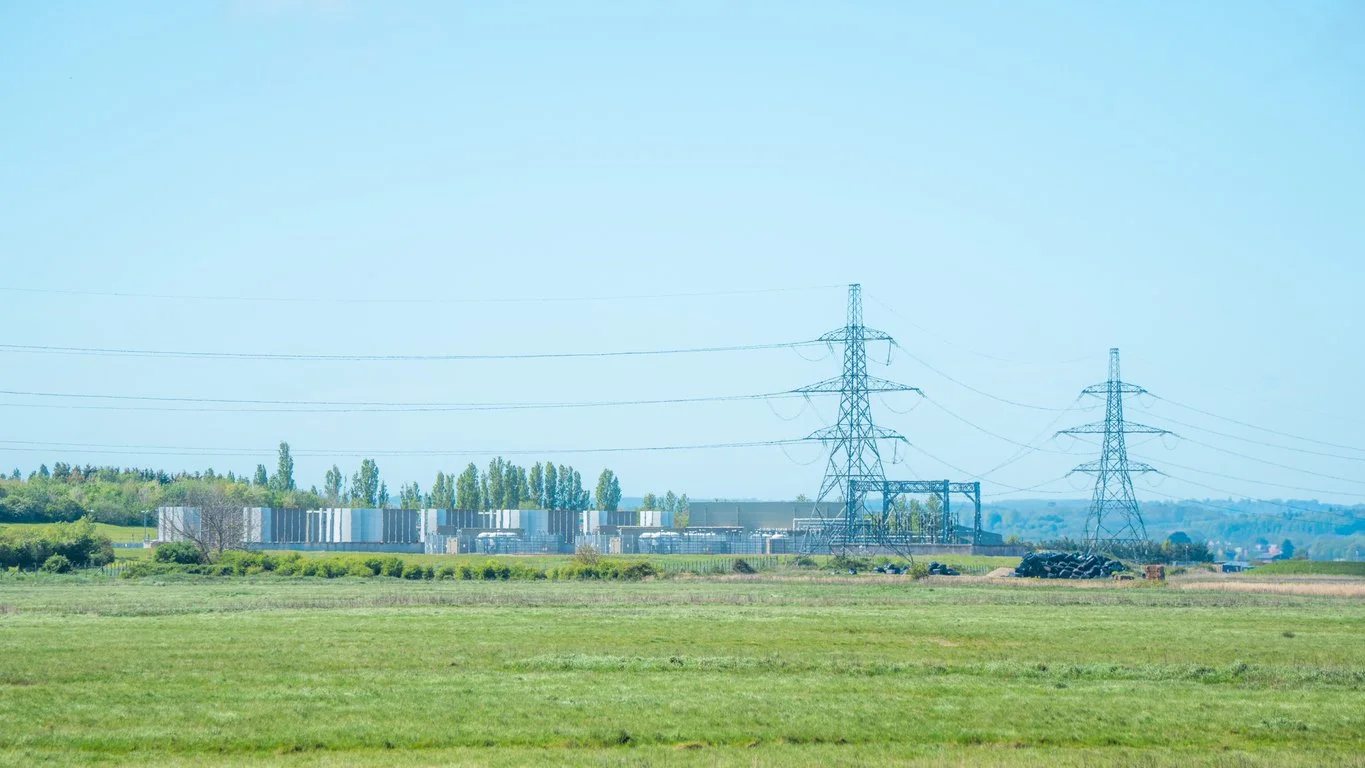
Electricity pylons and data centre across a rural setting in the UK
The debate
On 28 October, HM Treasury published the Data Centre Covenant alongside the Budget. The argument since has settled into a familiar shape. Campaigners call it voluntary at best and a way for some projects to skip the grid connection queue. Developers say priority access means little without the substations to deliver it.
Both sides are arguing about who gets access. That is a fair question. It is not the one that will decide whether the policy works.
The Covenant is about time. It decides which projects get power first. In one short clause, it also decides what fills the gap while they wait. Neither side is asking what that clause leaves behind.
Rationing without a rule
Britain’s queue of demand projects waiting for a grid connection grew from 41 gigawatts (GW) in November 2024 to 125 GW by June 2025, according to Ofgem, the energy regulator. Data centres account for at least 80 GW of that queue. The government estimates the country needs 6 GW of AI data centre capacity by 2030.
Set those numbers side by side and the Covenant's purpose is clear. Most of the data centre queue will not connect this decade. The Covenant decides which part does.
It does this through five tests: lower bills, investment in local communities, environmental standards, jobs, and national security. Projects that pass, and that the government judges "strategic," can receive reserved grid capacity, capacity released when other projects leave the queue, transfers of existing pre-2030 connection contracts, and in the last resort, permission to generate their own power on site.
The government has not yet said what "strategic" means. The Covenant says details will follow in due course. Law firms reviewing it in early November noted there is no definition of either "strategic" or "exceptionally strategic".
This is the problem I describe as the Temporal Trilemma. The energy trilemma asks policy to balance security, affordability and sustainability but it has no time axis. Here the deadline is fixed at 2030 and the rule that allocates the scarce resource has not been written. Every month spent defining "strategic" comes out of a window that closes in a little over three years. A developer cannot finance a project against a category that does not yet exist.
Temporary describes the permit, not the plant
The on-site power clause is narrow and the government will develop a tightly controlled framework allowing on-site generation until a grid connection can be secured. It applies only to exceptionally strategic projects, only where the grid measures cannot deliver in time, and subject to conditions on energy security. Lawyers have noted it appears to envisage some relaxation of electricity licensing or consenting rules. It is a real policy instrument and not a footnote.
The clause treats on-site generation as a bridge. That describes the need accurately but it describes the asset poorly.
Gas engines, gas turbines and fuel cells are typically designed to run for 15 to 20 years or more. A plant built in 2028 to cover a three-year gap can physically run into the late 2040s. "Temporary" describes its permit. It does not describe the equipment, the financing, the fuel contracts or the people trained to operate it. This is what I call Infrastructure Half-Life: the period over which an asset keeps its economic and societal relevance, as distinct from its engineering lifespan.
A bridge with no designed exit has two possible endings. It strands, and the cost falls on whoever financed it, or it becomes permanent through a series of reasonable extensions or adaptations without anyone deciding that it should. The Covenant intends neither outcome but it does nothing to prevent either.
When the grid reaches the site, the owners of these assets will have three options: repurpose the units, sell them, or scrap them. Scrapping writes off equipment with years of working life left. Selling moves it to another site. In most cases, the units will keep running after the grid arrives, on site or elsewhere. Policy should therefore give these assets a clear defossilisation pathway, meaning a planned route away from fossil fuels.
The Covenant asks for what it restricts
The Covenant asks data centers to support an efficient, flexible and resilient energy system. It commits the government to developing flexible connections and backstop operational control measures. In plain terms, that means the grid operator could reduce or interrupt a data centre's supply when the system is under stress. It also asks operators to capture waste heat for nearby homes, schools, hospitals or businesses wherever practical. Each of these is sensible but each also depends on having power available on site.
A data centre that can be curtailed without losing service needs another source of electricity during the curtailment. For most facilities today, that is standby diesel generation. Standby units are built to cover outages, not to support the grid routinely, and their running hours are limited by emissions rules. Offering genuine flexibility means dispatchable capacity designed for frequent use: batteries for short events, power generation for longer ones.
Heat works the same way. Server halls produce large volumes of low-temperature heat, typically around 25 to 45°C (77 to 113°F) . Most district heating networks need water well above that. Closing the gap takes heat pumps, which consume more electricity. On-site generation produces heat at temperatures a network can use directly.
So the Covenant asks for flexibility and heat reuse, and restricts the class of asset best placed to provide both. That is not an argument for allowing on-site generation freely. It is an argument for writing its rules deliberately, rather than treating it as an exception.
The strongest objection
The strongest case against on-site generation is lock-in. Britain's grid is decarbonising quickly. Most on-site generation available at scale today runs on natural gas. Every gas plant built beside a data centre adds fossil fuel demand that may outlast the grid's own transition. Campaigners have already criticised the Covenant for explicitly allowing on-site fossil generation.
That risk is real, and the market is already testing it. Reabold Resources welcomed the Covenant and is running a feasibility study on co-locating a data center at its West Newton gas field, with on-site power fueled directly from the field rather than the national gas grid. It is a study, not a project and it still shows that some investors read the bridge as a destination.
The objection points at the Covenant's design, not at on-site power as such. A permit that sets conditions on entry and none on exit invites permanence. The answer to lock-in is not to make on-site power rarer and less planned. It is to make the exit part of the permit.
Regulate the trajectory
I would add four conditions to the on-site generation framework the government is now drafting. They apply to any technology: engines, turbines, fuel cells or batteries.
A defined handover. At consent, the developer states what the asset does on the day the grid connection arrives. The options are to export flexibility to the grid, to remain as standby only, or to be decommissioned by a fixed date, the choice is recorded and enforceable.
A dated fuel pathway. If the asset burns fossil gas, the permit names a route away from it, with dates. That could be biomethane (gas from organic waste, upgraded to the same quality as natural gas) or equipment able to run on hydrogen. Standby diesel generators can usually run on hydrotreated vegetable oil (HVO), a renewable diesel made from waste oils and fats, with little or no modification.
A tested heat offtake. "Wherever practical" becomes either a named heat user with a connection plan at consent, or a clear statement that none exists.
Reporting against the path. Strategic data centres will already report annually on energy, water, emissions, heat reuse and flexibility. That report should also show progress against the handover and fuel conditions.
These conditions fit inside the framework the government has already committed to write, they do not require a new regime.
The principle behind them is that control should follow an asset over its whole working life, not just the moment it is permitted.
What the definition should include
The government will soon set out what makes a data centre strategic. Consultation on the draft Data Centre National Policy Statement runs until 8 January 2027. Both are chances to fix this.
The Covenant already says which projects may build their own power while they wait. It should also say what that power becomes when the wait is over. That one addition would turn an emergency measure into a planned part of the system.
Five Nines and Fast Power
Power Strategy For Data Centers, AI Infrastructure and Digital Investment
Questions and answers
What is the UK Data Centre Covenant?
A policy paper published by HM Treasury on 28 October 2026, alongside the Budget. It sets five tests for data centres: lower electricity bills, investment in local communities, environmental standards, jobs and skills, and national security. All data centres are encouraged to meet them. Strategic data centres must meet them to qualify for faster grid connections and planning support.
What counts as a strategic data centre?
The government has not yet defined it. The Covenant says details of the definition, and of the additional criteria strategic projects must meet, will follow in due course.
Does the Covenant allow data centres to generate their own power?
Yes, in limited cases. The government will develop a tightly controlled framework permitting on-site generation until a grid connection can be secured. It applies only to exceptionally strategic projects, only where other measures cannot deliver capacity in time, and subject to conditions on energy security.
Why does on-site power need an exit rule?
The Covenant treats on-site generation as temporary, but generating equipment is typically designed to run for 15 to 20 years or more. When the grid arrives, owners can repurpose, sell or scrap the units. Scrapping writes off working equipment, so most units will keep running somewhere. Without conditions on what happens next, a temporary measure can become permanent by default.
What is a defossilisation pathway?
A planned route for moving an asset away from fossil fuels over time. For on-site generation, that could mean switching to biomethane, which is gas made from organic waste and upgraded to natural gas quality, or to hydrogen-capable equipment. Where no credible route exists, the asset would have a fixed closure date.
How much AI data centre capacity does the UK need?
The government estimates 6 GW of AI data centre capacity by 2030. By June 2025, Ofgem reported 125 GW of demand projects in the grid connection queue.
How can I respond to the government’s proposals?
The consultation on the draft Data Centre National Policy Statement is open until 8 January 2027.