Why Is The Structured Transition Model New?
For those of you who have been following the publication of the Structured Transition Model, there is a reasonable challenge to answer. What is actually new here? On the face of it that is fair. The key components, onsite gas generation, energy efficient thermal use through combined cooling heat and power, microgrid integration, grid import and storage, have all been discussed and deployed for years. That is correct. None of these technologies is new in its own right. So if the parts are established, where is the value?
It sits in the order of deployment, and in a reality most buyers are never asked to plan for. A power asset built today will run for decades. Over that life it will see several changes of federal and state government, and each of those can move the economic value of the facility. Incentives appear and expire. Carbon rules tighten in one term and loosen in the next. The sequence a developer commits to at the start decides how well the asset absorbs those swings, or whether it is stranded by them.
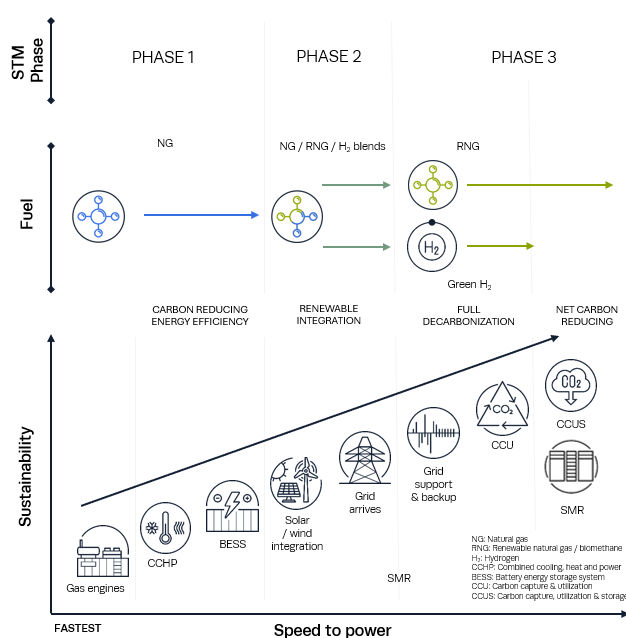
The Structured Transition Model Schematic (Alex Marshall, Rehlko 2026)
An asset investor is rarely shown that evolution. They are shown a configuration for today addressing the immediate needs of the energy trilemma, but not suggesting variability over time.
The reason for this gap is straightforward, and it is not a failing on the developer's part. These technologies matured in one market. Industrial and utility power has been sequencing generation, managing cost and balancing reliability against carbon as routine work for decades. The demand is now arriving in a different market. Data center developers are building power-hungry sites at a scale and pace that puts them into exactly those decisions, and the two markets have not yet met. The people who know these technologies and the people building data centers are, for the most part, in different rooms.
Right now data center development is optimized for two things. The first is reliability, the five nines standard of 99.999 percent uptime. The second is speed-to-power, how quickly a site can be energized. Decarbonization is treated as a later problem. The difficulty is that the order chosen at the start determines the options available later. Commit to the wrong sequence and grid constraints, policy and cost arrive as a trap rather than a plan. The expensive version of this problem is the one met after the site is built.
The Structured Transition Model puts that order in front of the buyer before it is forced on them.
The strongest form of the objection is that the parts are old, so anyone could assemble this themselves. They could. But a set of known tools is not the same as a decision a buyer can act on, and the connection between the two markets has not been made. Sequencing established technologies for a market that has not yet been served is the actual work, and for data center power it has not been done.
I saw ten years ago that onsite power would help supply data centers when the grid could not deliver, I’ve also seen developers opting to deploy less sustainable and less future ready technologies. The sequencing problem follows directly from that. Once power is the binding constraint, the order in which you bring capacity online, and how you decarbonize it without losing reliability or speed, becomes the central question rather than a closing footnote. The constraint was visible early. The framework is what you build once you take it seriously.
So the honest answer to why this is new is straightforward. The components are old. The order, applied to data center power for a buyer who has not yet connected it, and planned across an asset life that will outlast several policy regimes, is where the value sits. The model does not claim to invent the tools. It claims that the order matters, that getting it wrong is costly, and that the people making the decision have not yet been handed a way to make it well.
Five Nines and Fast Power
Making Better Decisions in AI Energy Investments
Questions and Answers
What is the Structured Transition Model (STM)?
The Structured Transition Model (STM) is a sequencing framework for data center power. It sets the order in which a developer brings power capacity online and decarbonizes it without losing reliability or speed. The technologies it uses are established. The contribution is the order in which they are applied.
If the technologies are established, what is new about STM?
The technologies behind STM, including onsite generation, combined heat and power (CHP), biogas, microgrids, grid import, and storage, are proven and decades old. What is new is the order, applied to data center power for a buyer who has not yet been given it. STM does not claim to invent the tools. It claims the order matters.
Why aren't data center developers already sequencing power this way?
These technologies matured in industrial and utility power, a different market from data center development. The two have not connected. Data center developers are currently optimized for reliability and speed-to-power, and treat decarbonization as a later problem. That is where the market sits today, not a failing on the developer's part.
What does getting the power sequence wrong cost a data center developer?
The order chosen at the start determines the options available later. Commit to the wrong sequence and grid constraints, policy, and cost arrive as a trap rather than a plan. The expensive version of the problem is the one met after the site is built.
What is speed-to-power?
Speed-to-power is how quickly a data center site can be energized and brought into service. Alongside reliability, measured by the five nines standard of 99.999 percent uptime, it is one of the two priorities data center developers currently optimize for.
How does STM connect to the claim that power, not compute, constrains AI infrastructure?
Power, not compute, is currently the binding constraint on AI infrastructure. Once power is the constraint, the order in which capacity is brought online and decarbonized becomes the central question rather than a closing footnote. STM is the framework built on that premise.